Humpback Whales In Cabo: Breaching, Songs And The Winter Migration
What humpbacks are doing off Cabo each winter, how to read a breach, a tail slap and a spyhop, why hydrophones pick up singing males, and which month and which boat suit what you want to see.
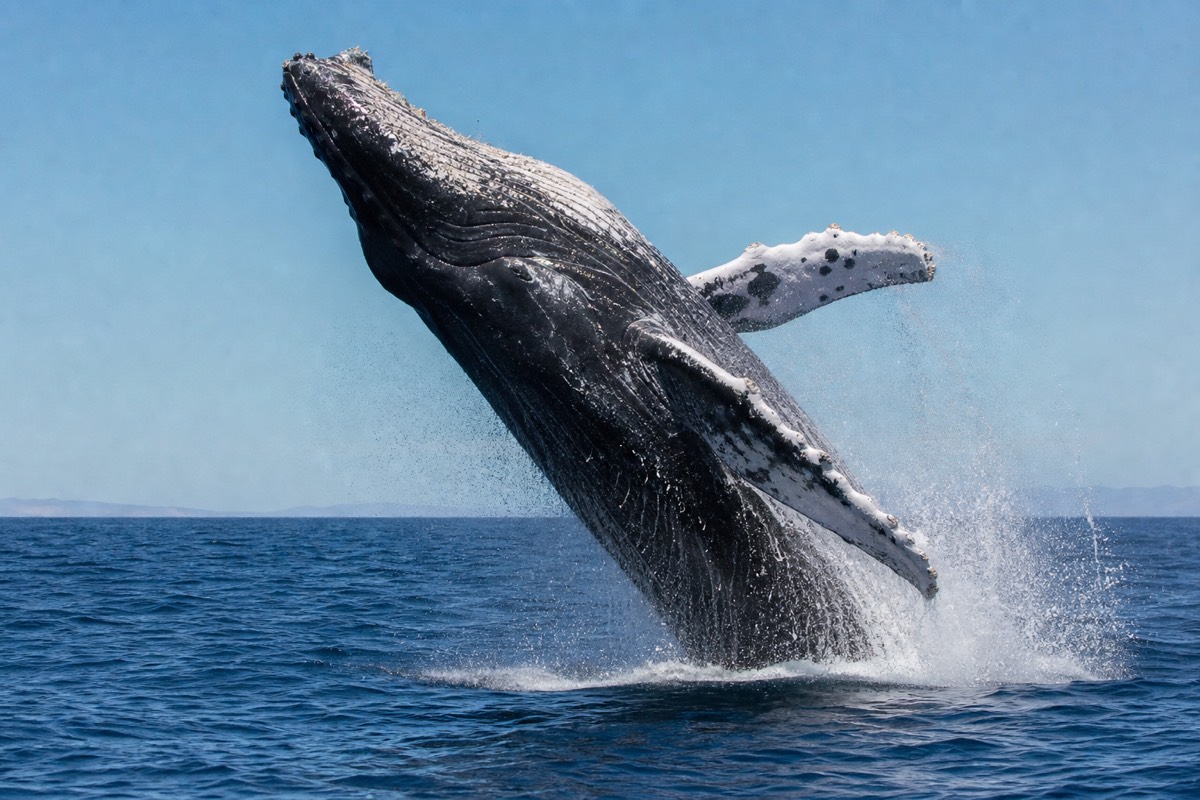
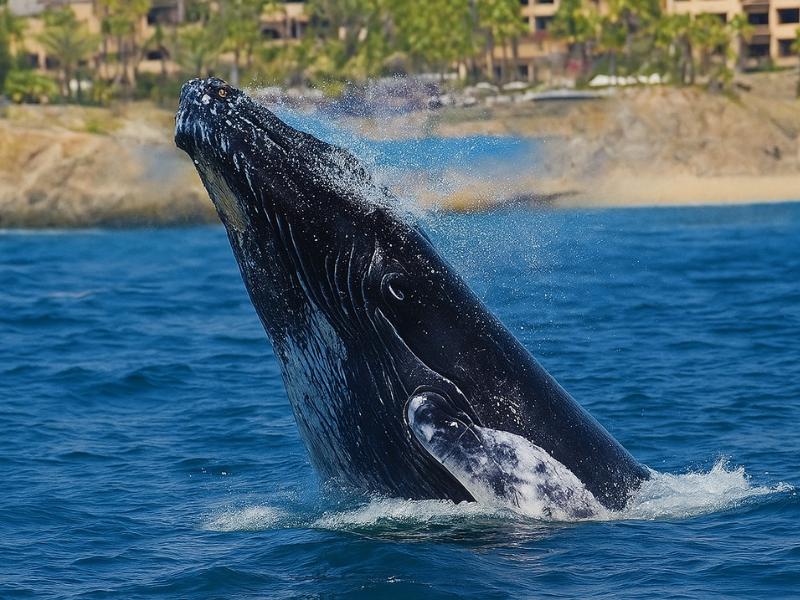
A humpback breach is the sound before it is the sight. Roughly 40 tons of animal leaves the water and comes back down, and on a small boat a few hundred metres away you feel the thump in the deck before your eyes catch up. That is the moment most people book a whale trip for, and it is only one item on a long list of things humpbacks do in Baja water between December and April.
This guide covers why they winter here, what each surface behaviour probably means, how hydrophones put singing males on the boat speaker, where sightings cluster between the Pacific and the Sea of Cortez, and which of the shared departures suits which interest. Species figures come from NOAA Fisheries. Prices and ratings come from the operators' live listings, which is where you should confirm them.
Humpback sighting odds through the Cabo season
January through March is the strongest seasonal match. Wild sightings remain unpromised, and any operator-specific terms belong on the live listing.
The behavior guide becomes more useful when the boat format matches whether you want interpretation, hospitality or private group time. Compare The Cabo Tour Options Below →
January through March is the strongest humpback window. Choose the biologist trip for behavior and a conditional hydrophone, the catamaran for meal and transfer, or private for your own group.
Why Do Humpbacks Spend The Winter Off Cabo?
They come to breed and to give birth. Humpbacks feed hard all summer in cold northern water, then swim roughly 3,000 miles south to spend December through April around Baja, where a newborn calf with almost no blubber can survive. They barely feed the entire time they are here, living instead on what they stored up north.
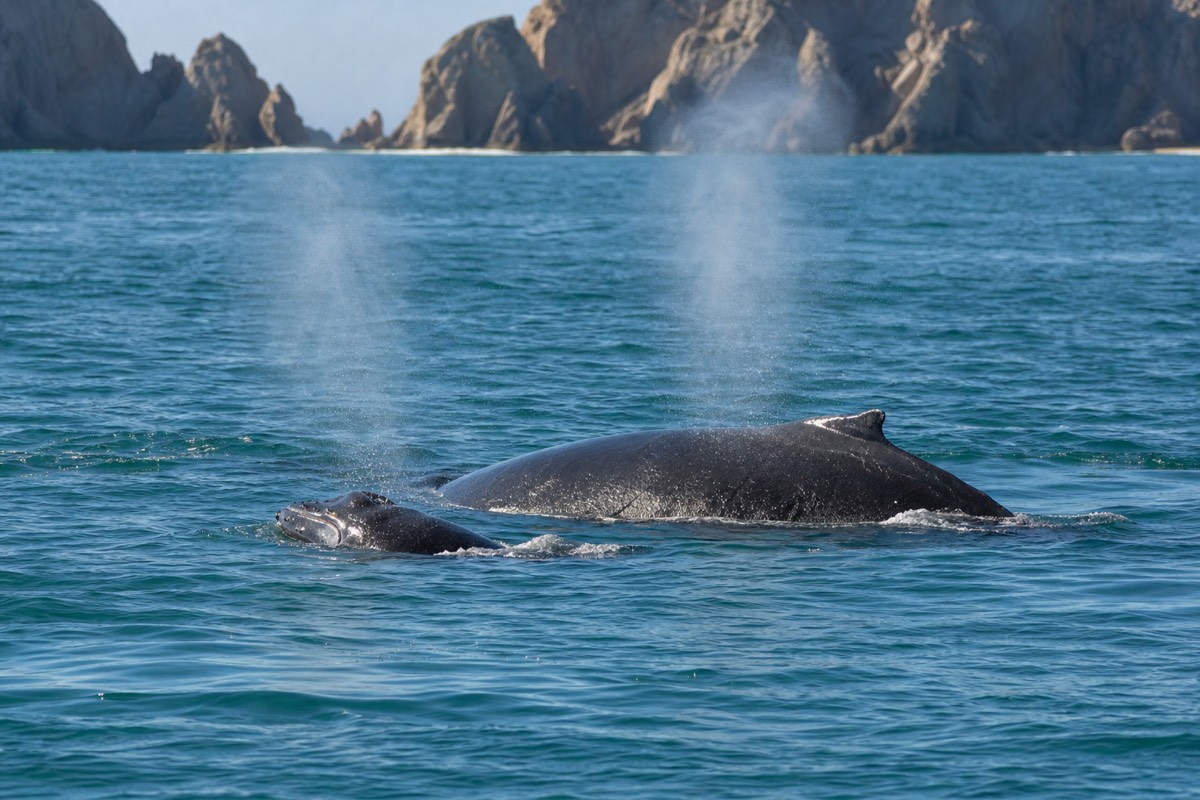
Cabo San Lucas sits at the exact point where the Pacific meets the Sea of Cortez, which is why the town punches above its weight for whale watching. Two bodies of water, two sets of conditions, one marina in the middle. A captain leaving the dock can turn west into open Pacific swell or east into the calmer Cortez side depending on the wind that morning, and whales are in both.
The seasonal window centers on mid-December through mid-April, with the strongest planning match in January through March. December and April require an exact-date check, and wild sightings remain unpromised.
What the whales are doing shifts across those four months. January and February are about competition and courtship, with groups of males shadowing a single female and the surface activity that comes with it. March and April are about calves. The gray whale migration to the Baja lagoons overlaps the same window, which is why both species show up on the same trip reports.
What Does A Breach Actually Mean?
Nobody has settled it. A breach throws most of a 40-ton animal clear of the surface and lands with a sound that carries for miles underwater. The leading explanations are long-distance communication, shaking off barnacles and whale lice, and display during competition between males. On a February morning in Cabo you can watch all three contexts.
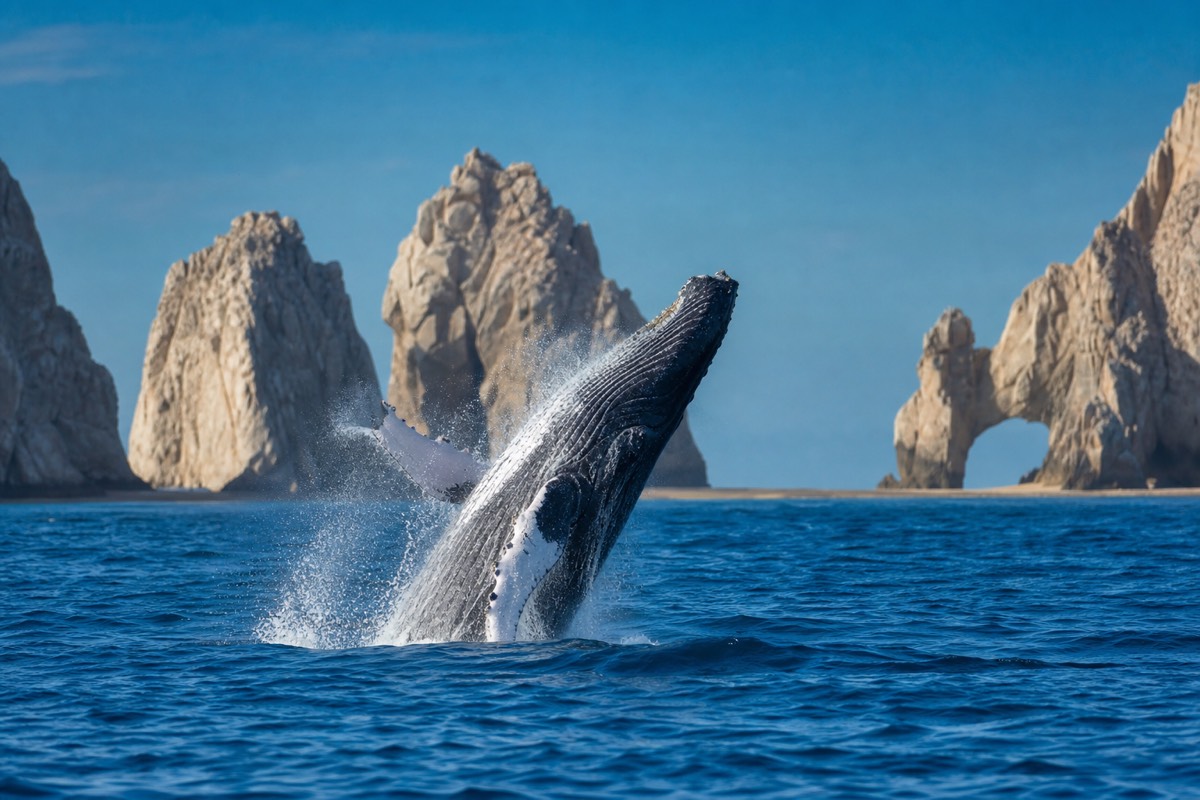
Breaches often come in series. A whale that goes once will frequently go again, sometimes five or six times, occasionally more, and the interval is short enough that if you missed the first one you have a real chance at the second. Crews know this, which is why a good captain holds position after a breach instead of moving on.
Context tells you a lot. A breach in the middle of a competitive group, with several males jostling and blowing hard, reads as display. A single animal breaching repeatedly in flat water with nothing else around reads more like the parasite theory or simple play. A calf breaching badly, half clearing the water and flopping sideways, is a young whale learning a skill it will need.
The practical point for a visitor: breaching is not guaranteed on any given trip, in any month, on any boat. Sightings in peak season are close to certain. Aerial displays are not. Any listing that promises breaching is promising something it does not control.
What Is The Whale Telling You With Each Behavior?
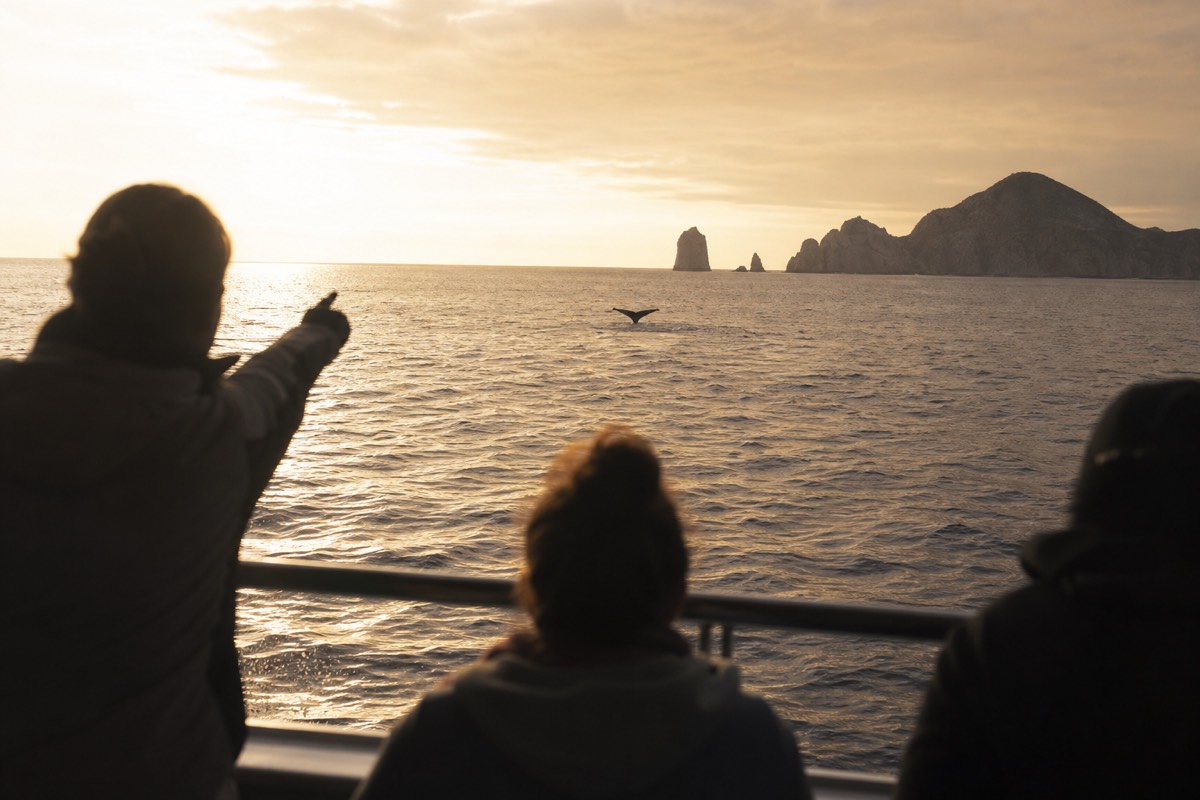
Humpbacks communicate with their bodies as much as their voices, and most of the surface repertoire has a plausible meaning attached. Blows mean breathing. Slaps make noise on purpose. Spyhops mean looking. Fluke-up dives mean the animal is going deep and will be gone for several minutes, so you can lower the camera.
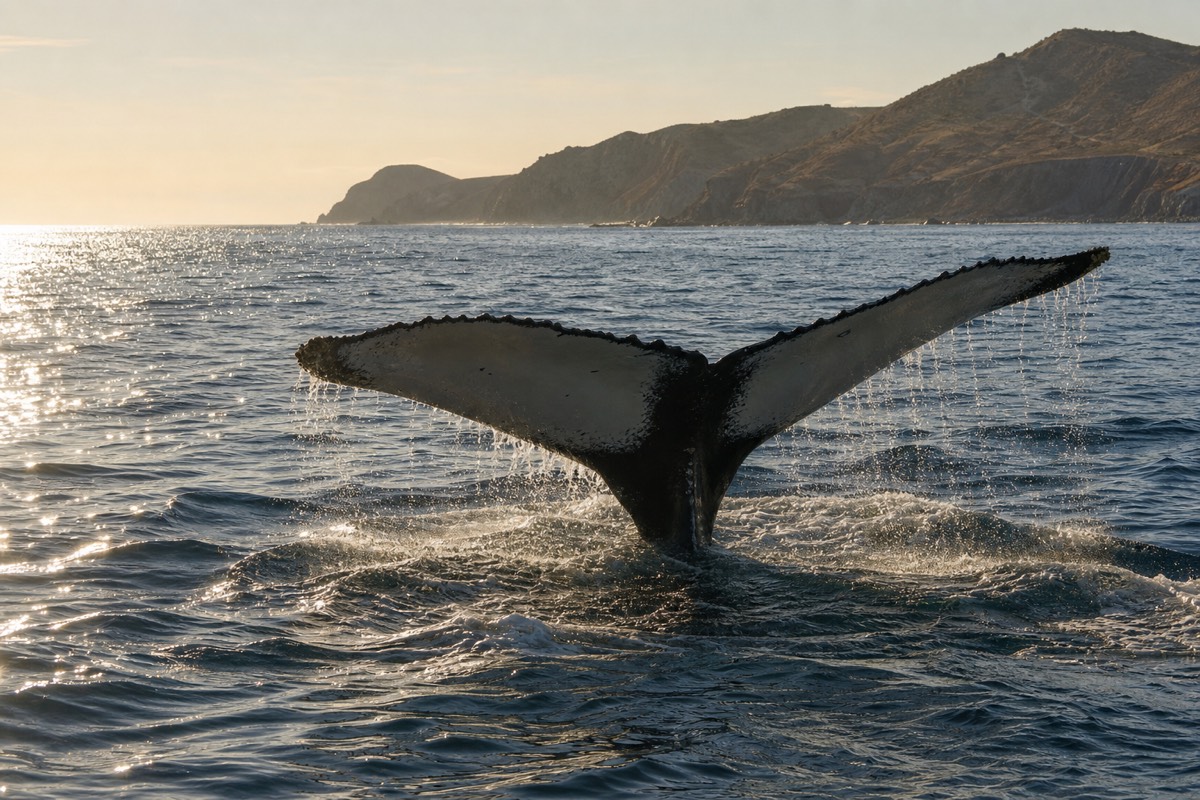
Learning four or five of these turns a trip from watching shapes into reading behaviour, and it makes the biologist's commentary land. It also improves your photographs, because you stop reacting and start anticipating. The table below covers what actually turns up off Cabo through the season.
| Behavior | What you see | What it usually signals | Most likely when |
|---|---|---|---|
| Blow | A tall bushy column of vapour | The whale is exhaling at the surface | Every sighting, all season |
| Breach | Most of the body clears the water | Signalling, parasite removal or display | January and February, competitive groups |
| Pectoral slap | A long white flipper repeatedly hits the surface | Sound-making; often social, sometimes play | Any month, common in calm water |
| Tail slap | The fluke is thrown down flat, hard | Communication or annoyance; carries far underwater | January to March |
| Peduncle throw | The whole tail stock is swung sideways | Aggression, usually between competing males | Peak courtship, January and February |
| Spyhop | The head rises vertically, eye above water | The whale is looking at boats or the horizon | Any month, more often near quiet boats |
| Fluke-up dive | The tail lifts clear before the animal disappears | A deep dive is starting; expect several minutes | All season |
| Logging | The whale floats still at the surface | Resting, often a mother conserving energy | March and April, mothers with calves |
| Competitive group | Several whales moving fast, blowing hard, jostling | Males competing for access to one female | January and February |
| Calf breaching | Small, clumsy, repeated attempts | Practice; the calf is building muscle for the swim north | March and early April |
Can You Really Hear Whales Singing From The Boat?
Yes, on boats that carry a hydrophone. Only male humpbacks sing, they do it on the winter breeding grounds rather than the northern feeding grounds, and a singer strings repeating phrases together for long stretches. Dropped over the side with the engine off, a hydrophone puts that straight onto the boat speaker.
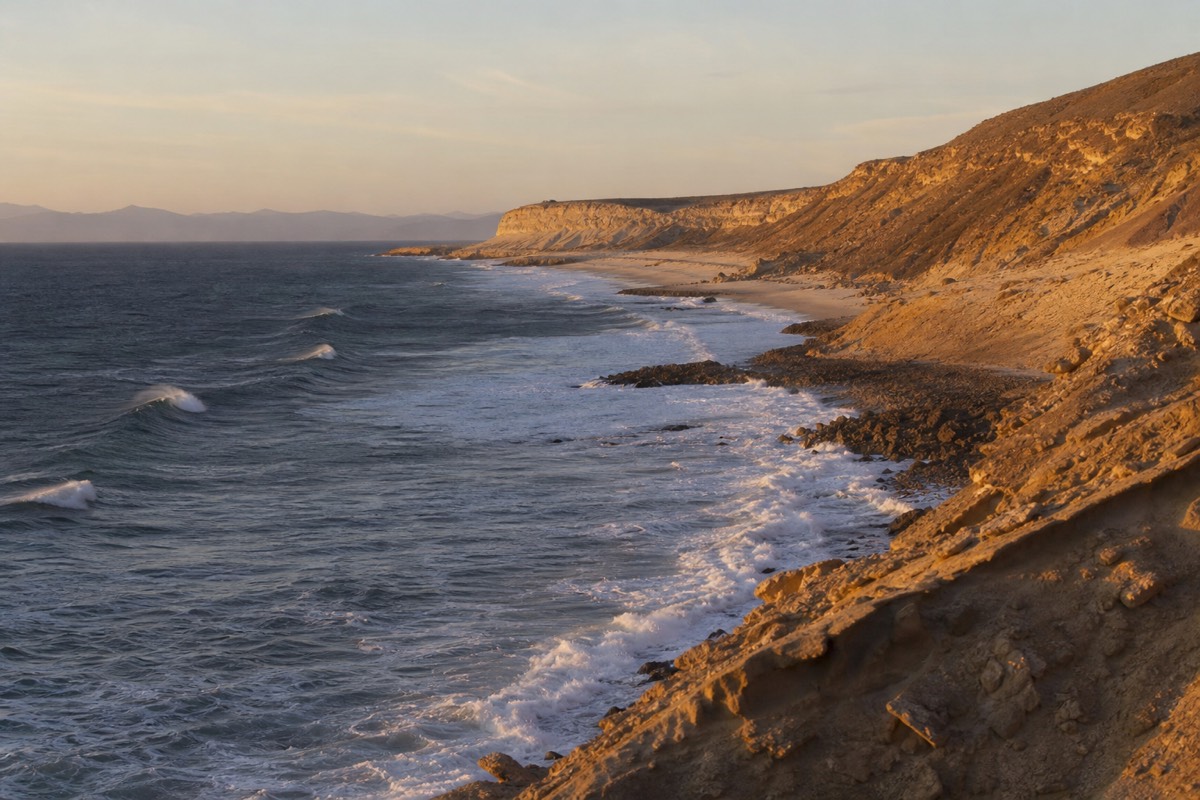
A singing male is easy to miss visually, because he does the opposite of everything that attracts attention. He hangs head-down in the water column, motionless, and surfaces only to breathe. Crews find singers by listening, not by looking, which is one reason a biologist-led boat with a hydrophone finds things a fast sightseeing cruise does not.
The song itself is structured. Phrases repeat in themes, themes repeat in sequence, and males across a population sing versions of the same song that drift and change through the season. Hearing it through a speaker on a small boat, with the engine off and nobody talking, is the part of the trip people describe afterwards more often than the breaching.
The verified small-group trip lasts 2.5 hours and caps the group at 12. It includes guide photos, water and a restroom, and the hydrophone is used when conditions allow. Check the live listing for the current date and availability.
How Big Is A Cabo Humpback, Really?
Adults reach around 60 feet and roughly 40 tons according to NOAA Fisheries, with pectoral fins longer than any other whale, up to about a third of the body. That is a flipper the length of a small car on each side. Calves arrive at about 13 to 16 feet, which already outsizes the panga you might be sitting in.
Numbers on a page do not prepare anyone for the scale. What does help is a reference point: on a boat carrying twelve people, a surfacing adult humpback is longer than the boat, and the flipper you see flash white underwater is longer than you are tall. The first close surfacing is usually met with silence rather than noise.
The white underside of the fluke is the identification key. The pigment pattern on each animal's tail is unique, and researchers use photographs of it the way police use fingerprints, which is how individual whales get tracked across decades and thousands of miles. When a guide says the boat has seen this particular whale before, that is where the claim comes from.
| Fact | Detail |
|---|---|
| Adult length | Up to around 60 feet (NOAA Fisheries) |
| Adult weight | Up to around 40 tons |
| Pectoral fins | The longest of any whale, up to about a third of body length |
| Calf at birth | Around 13 to 16 feet |
| Individual identification | Unique pigment pattern on the underside of the fluke |
| Journey to Baja | Roughly 3,000 miles from northern feeding grounds |
| Time spent in Cabo water | The regulated season, December 15 to April 15 |
| Feeding while here | Almost none; they run on stored blubber |
Which Month Gives You Which Humpback Behavior?
January and February deliver the aerial season: competitive groups, breaching males and singing. March and early April deliver the calf season: mothers logging at the surface with newborns, slower and closer. December is the gamble at 60 to 80 percent odds, and November is not whale season at all.
Holiday periods can affect departure availability. Check the live listings when your dates are fixed instead of relying on a month-by-month lead-time or sellout claim.
If your dates are fixed rather than flexible, work the other way round and pick the boat that fits the month. A March trip is better spent on a small quiet boat that can sit with a mother and calf than on a large vessel built for a party. The month-by-month season calendar covers weather and crowds alongside the whales.
| Month | Sighting odds | Dominant behavior | Booking lead time |
|---|---|---|---|
| November | Not whale season; 80-90% disappointment | Dolphins, and luck | Not applicable |
| December 15 to 31 | 60-80% | Early arrivals, scattered singles and pairs | 2-3 weeks |
| January | 95% and better | Competitive groups, breaching, singing males | 3-4 weeks |
| February | 95% and better, peak density | The full behavioral range, most animals in the water | 6-8 weeks (Presidents Day) |
| March | 95% and better | Mothers with calves, logging, calf practice breaching | 6-8 weeks (Spring Break) |
| April 1 to 15 | Departing whales, still good | Mother and calf pairs heading north, quiet boats | 2-3 weeks |
Morning Or Afternoon: When Are Humpbacks Most Active?
Morning is the better bet. The 8am departures get the calmest seas, the softest light and whales that have rested overnight. The 2:30pm boats trade flat water for warmth and sometimes catch more surface activity as the day heats up. Pricing is identical, so the decision is about sea state and light, not money.
Wind is the mechanism. Baja mornings tend to start still and build through the day, so the same stretch of water that is glassy at eight can be lumpy by three. Flat water matters more than most people expect: it makes blows visible at distance, it makes photography possible, and it keeps queasy passengers looking at whales instead of the horizon.
Morning departures often offer a useful combination of cooler air and favorable light, but conditions still vary. Compare the live verified products for your date and read the boat details before choosing a departure time.
| What differs | Morning (around 8am) | Afternoon (around 2:30pm) |
|---|---|---|
| Sea state | Calmest; wind usually has not built | Choppier as afternoon wind fills in |
| Light for photographs | Low, soft, angled; best of the day | Harsh overhead, then warm late |
| Whale activity | Active after overnight rest | Variable; sometimes more surface display |
| Deck temperature | Cool; a windproof layer earns its place | Warm, occasionally hot |
| Seasickness risk | Lower on flat water | Higher with chop |
| Availability | Sells out first, especially small boats | Easier to get at short notice |
| Price | Identical | Identical |
Pacific Side Or Sea Of Cortez Side: Where Do Sightings Cluster?
Both hold whales all season, and captains choose by wind rather than by rule. Cabo sits at the meeting point, so a boat can turn either way within minutes of leaving the marina. The Cortez side is usually calmer and the default on a windy morning. The Pacific side runs bigger swell and often more animals in transit.
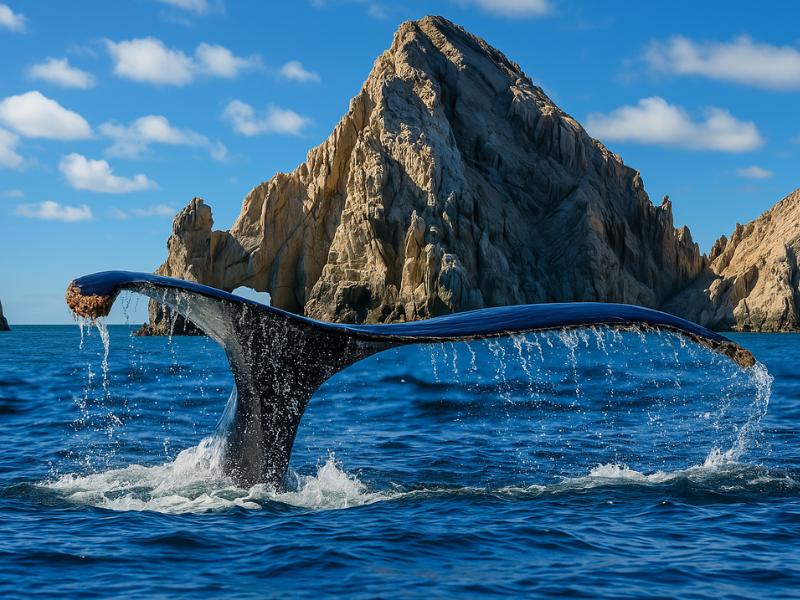
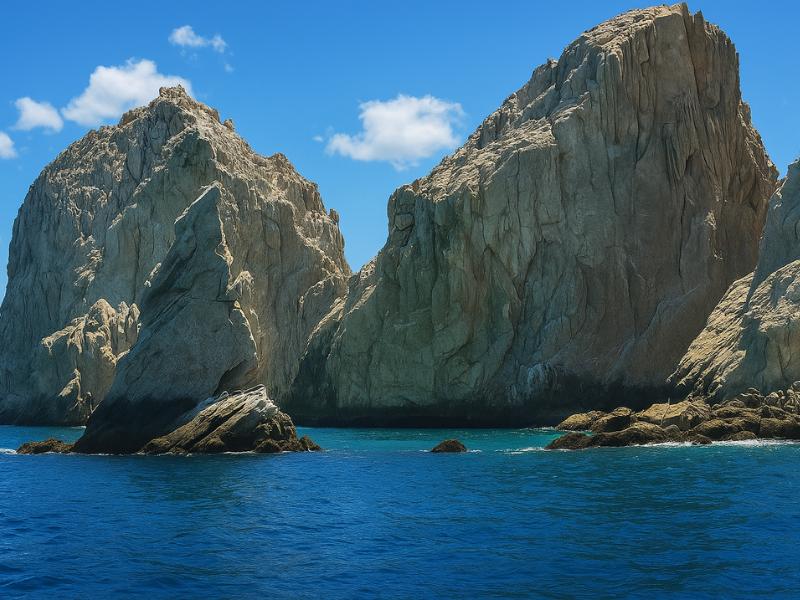
Land's End is the hinge. El Arco, Lover's Beach and the sea lion colony on the rocks all sit at the tip, minutes from the dock, which is why almost every trip runs past them before the whale search begins. That ten-minute stretch is also where you decide how you feel about the sea that day, because the water changes character the moment a boat clears the point.
Neither side is reliably better for whales. What differs is the experience of being there. Families and camera-carriers usually prefer the protected water. People who want the open-ocean feel, and do not mind being thrown around, get more of it out west. A captain who switches sides mid-trip based on radio traffic is doing the job properly.
| Where | Sea state | What tends to be there | Best for |
|---|---|---|---|
| Sea of Cortez side | Calmer, more protected | Resting groups, mothers with calves late season | Families, cameras, first-time boaters |
| Pacific side | Open swell, choppier | Travelling humpbacks, passing gray whales | People who want big-water conditions |
| Land's End itself | Sheltered, short hop from the dock | El Arco, Lover's Beach, the sea lion colony | The scenic run before the whale search |
How Close Can A Boat Legally Get To A Humpback?
Under Mexico's NOM-131 standard, the minimum observation distance for humpback and gray whales is 60 metres for smaller vessels and 80 metres for medium or larger vessels; boats waiting their turn remain 240 metres away. No more than four vessels may observe one whale or group, observation is limited to 30 minutes, and swimming or diving is prohibited. Approaches to a traveling whale run diagonally from the rear side and then parallel to its course.
The rules constrain the boat, not the whale. When a humpback closes the gap itself, and they do, the correct response is to put the engine in neutral and wait. Some of the closest encounters people describe happen exactly this way, with a curious animal surfacing beside a stationary hull while the crew says nothing and does nothing.
Permits come from SEMARNAT and licensed boats display them. That single detail separates the operators worth booking from the ones worth avoiding, along with a stated group cap and a guide who explains approach protocol rather than boasting about proximity. Anyone still hoping to get in the water should read swimming with whales in Cabo for the direct answer.
| Rule | What it looks like from your seat | Why it exists |
|---|---|---|
| Minimum approach distance | The captain stops well short and lets the whale move | Prevents strikes and stops boats crowding animals |
| Maximum four boats per group | Boats queue and take turns on radio | Keeps whales from being surrounded |
| Around 30 minutes of observation | You move on while the whales are still there | Limits cumulative disturbance |
| Parallel, slow approach | No head-on runs, no cutting across the path | Whales can see and predict the boat |
| Engine to neutral on approach | Sudden quiet when a whale comes close | Reduces noise and propeller risk |
| No swimming or touching | Everyone stays aboard, always | Safety for both species |
| Permit displayed | A visible SEMARNAT permit on the boat | Marks a licensed, accountable operator |
| Season limits | Trips run December 15 to April 15 | Matches the regulated whale watching window |
The IWC whale watching handbook is the international reference behind most of this, and it is the plainest short description of what responsible whale watching means in practice. Five minutes with it before a trip changes how you judge your own boat's behaviour.
Which Tour Type Fits Which Interest?
Pick by what you want from the trip. Identification, guide photos and a hydrophone when conditions allow point to the verified biologist-led small group. A light meal, domestic open bar and arranged hotel transfer point to the catamaran. Private group time, food and water activities point to the three-hour private trip.
The shared boats that Cabo Whale Tours lists all leave from the marina and all run around two hours, so the differences are group size, guiding and platform rather than itinerary. Small-group trips cap numbers in the low teens, which changes how much of the guide's attention reaches you and how quickly the boat can reposition when something happens.
Larger vessels have their own logic. A catamaran or a breakfast boat gives you shade, a toilet, food and a stable deck, which matters with young children or anyone nervous about motion. You give up some agility and some quiet. For a group that wants the water to itself, private whale watching charters start well above the shared prices and buy you the schedule as well as the boat.
| Tour type | Roughly | Rating and bookings | Best for |
|---|---|---|---|
| Small-group biologist boat, max around 12 | 2.5 hours; check live listing | Biologist, guide photos and hydrophone when conditions allow | Behaviour, identification, hydrophone songs, free photos |
| Zodiac with biologist, smaller cap | 2.5 hours; check live listing | Remove unverified product row | Photographers and anyone who wants eye-level water |
| Sunrise departure | Remove unverified product row | Remove unverified product row | Flattest sea, best light, lowest price |
| Catamaran or breakfast boat | 2 hours on the water plus transfer time; check live listing | Meal, domestic open bar and hotel transfer arranged 48 hours ahead | Shade, food, stability, mixed-age groups |
| Private yacht charter | 3 hours; check live listing | Food, drinks, snorkeling and paddleboard; confirm assigned boat | Groups wanting their own boat and schedule |
Prices move with season and demand, so treat every figure above as a starting point and check the live listing for what your dates actually cost.
What Changes When Mothers And Calves Arrive Late In The Season?
March and early April are the calf months, and the whole rhythm slows down. A newborn has small lungs and surfaces every few minutes, so mother and calf stay near the surface, logging and rolling rather than breaching. You trade explosive action for long, sustained, close viewing of two animals doing very little.
Mothers by this point are running on empty. They have not fed properly since leaving the north, they are producing rich milk in volume, and every unnecessary movement costs energy they cannot replace until Alaska. That is why a mother and calf pair will often tolerate a stationary boat nearby while an unencumbered adult would have moved off.
Escorts complicate the picture. Pairs are frequently shadowed by a single adult male who stays with them for hours or days, and his presence changes the behaviour of the group: more surface activity, more posturing if another male approaches. Watching that unfold over twenty minutes is a different pleasure from a breach, quieter and more informative.
Good crews give pairs more room than the minimum, cut the engine earlier, and leave sooner. If your boat does the opposite, that tells you what kind of operation you booked.
How Do You Tell A Good Captain From A Bad One Before You Board?
Look for a displayed permit, a biologist or trained naturalist actually on the boat, a stated group cap, and a description of how the crew approaches whales rather than how close they get. Listings promising to put you next to a whale, or to let you swim with one, are describing something Mexican regulations do not allow.
Do not use a sighting guarantee as a substitute for product fit. Wild encounters remain unpromised, and any operator-specific remedy or rebooking term must be read on the live listing.
Equipment tells you something too. A hydrophone, decent binoculars and a radio link with other boats indicate a crew that hunts by information rather than by luck. Free professional photos are a small thing that signals a boat expecting to find whales. If you want to compare the shared departures line by line before booking, the roundup of every Cabo whale tour compared does that job.
What Should You Do With Your Eyes And Your Camera?
Watch first, shoot second. Whales telegraph what is coming: a blow, then a back, then an arch, then a fluke. Learning that sequence has you pointed at the right patch of water before anything happens. Shoot in bursts, keep both eyes open, and accept that the best breach of the day will happen behind you.
Scanning beats zooming. The most useful skill on a whale boat is spotting a blow at distance, which you do by looking at the horizon line with wide vision rather than staring through a viewfinder at one spot. Crews find most whales this way, and passengers who learn it end up calling sightings before the guide does.
Keep the gear simple. Salt spray, a moving deck and cold fingers punish complicated setups, and a phone in a dry bag on a calm morning outperforms a big lens you cannot hold steady. Detailed settings, lens choices and positioning on the boat are covered in the notes on whale photography tips for Cabo.
One last thing. Put the camera down for at least one encounter. The people who talk about their trip years later are usually describing something they watched with their own eyes, not something they reviewed on a screen afterwards.