Gray Whale Watching In Baja: Full-Day Trips From La Paz
What the Baja gray whale migration is, why the Pacific lagoons are the nursery, how the verified eight-hour La Paz departure runs, and how to tell a gray from a humpback when both are in the same water.
The gray whales that fill the Pacific lagoons of Baja California every winter did not come for the scenery. They came because a newborn calf cannot survive its first weeks in Arctic water, and because these shallow, warm, unusually salty bays are the safest nursery on the eastern Pacific coast. That single piece of biology is what separates a gray whale day from a two-hour loop past El Arco and Lover's Beach.
This guide covers the migration itself, why the lagoon system on the Pacific side is where the calves are born, what the full-day trip out of Cabo actually involves, and how to read the difference between a gray and a humpback when both species are in the same stretch of water. Migration figures come from NOAA Fisheries. Tour details come from the operator's live listing, which is where price and pickup should be confirmed before booking.
The gray whale year in Baja California Sur
NOAA Fisheries puts the round-trip migration at roughly 10,000 to 14,000 miles, the longest of any mammal. Full-day lagoon trips from Cabo make sense January to March.
A gray-whale lagoon day is a different commitment from a short Cabo marina watch. Start with the species and endpoint you want, then compare the eight-hour La Paz product with the shorter Cabo alternative. Compare The Cabo Tour Options Below →
The verified gray-whale product lasts eight hours and starts in La Paz with lunch and refreshments. It has no Cabo transfer; choose the 2.5-hour biologist watch for a different Cabo-based experience, or the ten-hour whale-shark trip for a separate marine-wildlife day with Cabo transport.
How Far Does A Gray Whale Swim To Reach Baja?
Gray whales run one of the longest migrations of any mammal. NOAA Fisheries puts the round trip at roughly 10,000-14,000 miles between Arctic feeding grounds and the birthing lagoons of Baja California. They cover it twice a year at about three to five miles an hour, close to 80 to 100 miles a day, and they do most of it without stopping to feed.
The route hugs the coast almost the whole way. Gray whales are bottom feeders, so they stay over the shelf rather than crossing deep ocean, which is why people watch them from headlands all down the west coast of North America every spring and autumn. In summer they vacuum amphipods out of the mud in the Bering and Chukchi seas, packing on the blubber that has to last the entire trip south and back.
The population does not travel as one crowd. Pregnant females go first and go fast, because a birth that happens in open ocean is a birth that usually fails. Adult males and juveniles follow behind them through December. On the way north again in spring, the order reverses: the mothers with new calves leave last and stay so close to shore that they sometimes swim through kelp, keeping their young out of deep water where orcas hunt.
For a visitor booking in Cabo, that timing has a practical edge. A gray whale seen off Cabo in January is usually an animal in transit, moving with purpose and surfacing three or four times before a long dive. A gray whale inside the lagoon is settled, unhurried, and often accompanied by a calf that has nothing to do all day but be curious. Two different animals, in effect, on two very different trips.
| Planning period | Gray-whale product guidance |
|---|---|
| January through March | Eligible planning window; confirm a La Paz start and live date |
| December or April | Confirm that the product runs on the exact date |
| May through November | This gray-whale day is outside its planning window |
| Any Cabo start | Cabo transfer is not included; arrange arrival in La Paz before paying |
Why Do Gray Whales Choose The Baja Lagoons To Give Birth?
The Pacific lagoons give a newborn gray whale three things the open ocean cannot. Warm shallow water costs a thin calf almost nothing to stay warm in. High salinity makes a weak swimmer more buoyant. Narrow entrances and shifting sandbars keep orcas out. Mothers nurse there for weeks before attempting the swim north.
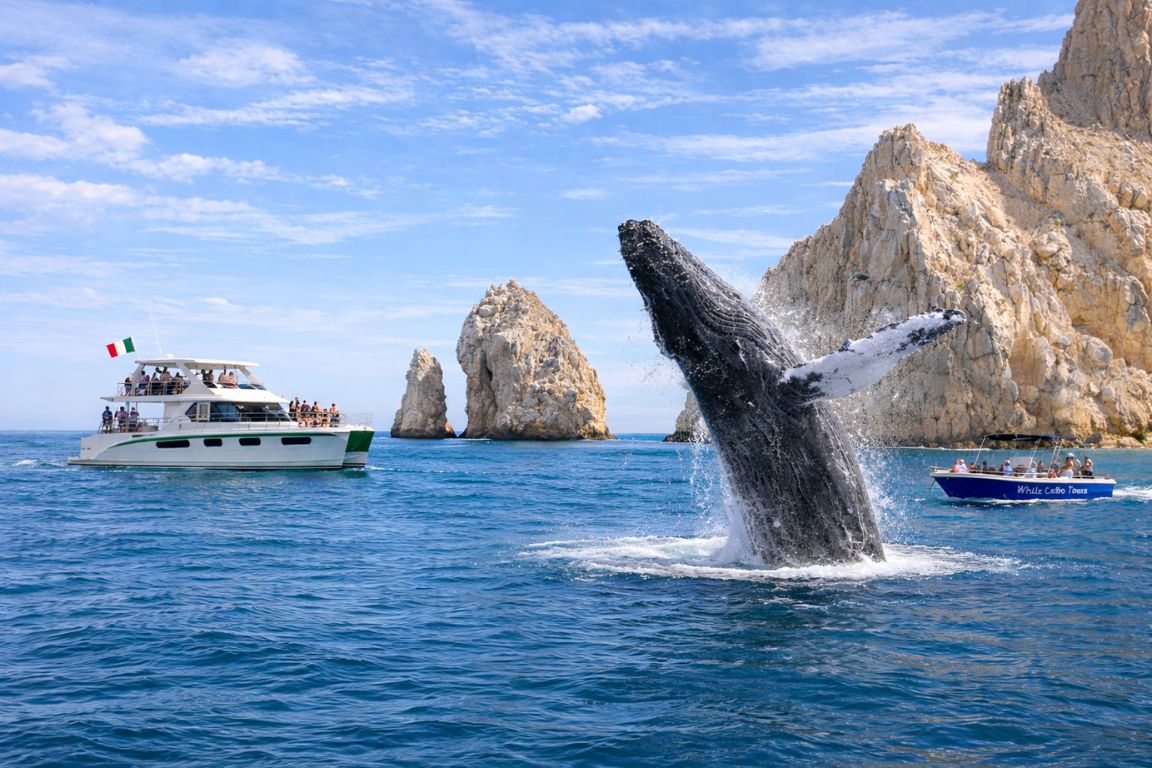
Evaporation in these bays is heavy and freshwater input is close to zero, so the water sits saltier than the ocean outside. A calf born into it floats a little higher and burns less energy on every breath. That sounds like a small advantage. Across six or seven weeks of near-constant nursing, with a mother who is barely eating, small advantages decide whether a calf reaches Alaska.
The Magdalena Bay system on the Pacific side is the southernmost of the big nursery bays, a long complex of channels, mangrove edges and barrier islands. The verified eight-hour product starts in La Paz, not Cabo; check its live route before assuming a particular lagoon or launch point.
Mangroves matter here too. The channels behind the sand barriers are nursery habitat for fish and a stopover for migrating birds, which is why the day includes a mangrove cruise rather than only whale time. Frigatebirds, herons, pelicans and, on some runs, bottlenose dolphins turn up between whale sightings. It is a different kind of watching from the Cabo boats, slower and closer to shore.
What Is A Friendly Whale, And Why Do Calves Approach Pangas?
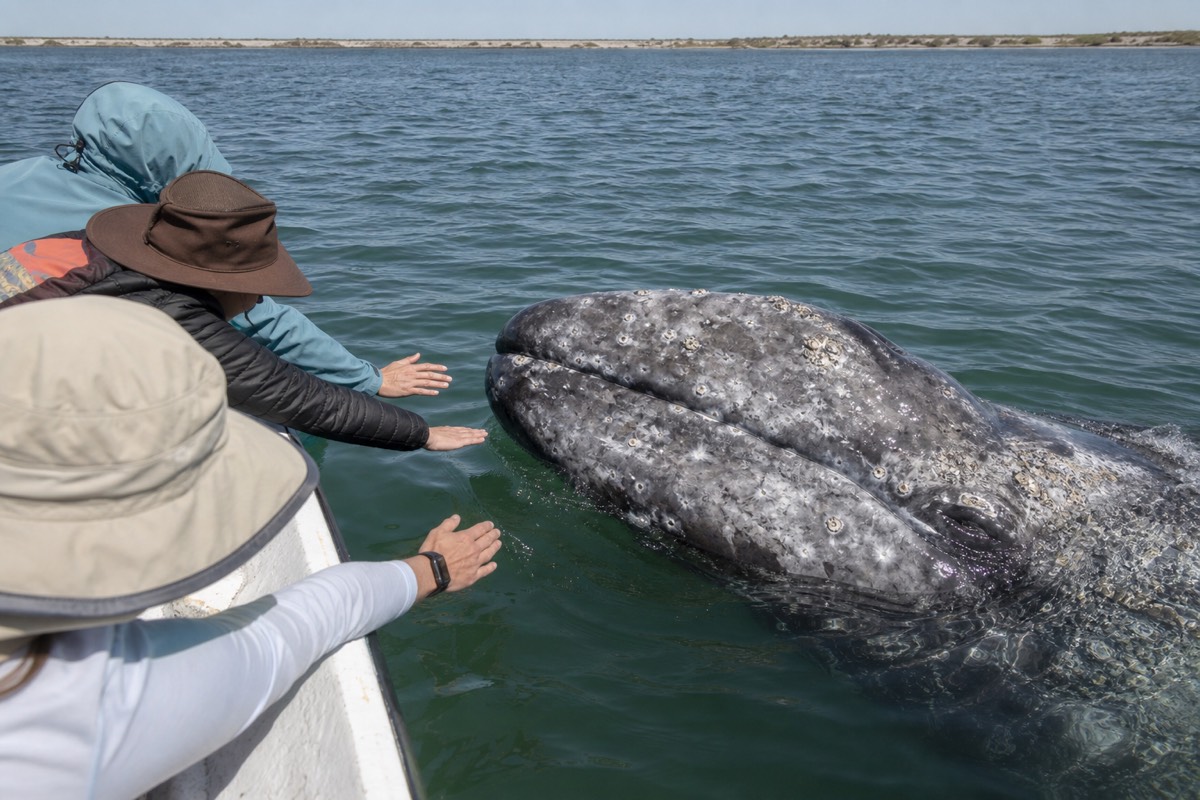
Friendly whale is the local term for a gray whale, usually a calf, that swims up to an idling panga and simply stays there. Baja fishermen first reported the behaviour in the early 1970s, and it has repeated in the same lagoons every winter since. The boat never chases. Engines go to neutral, and the whale decides.
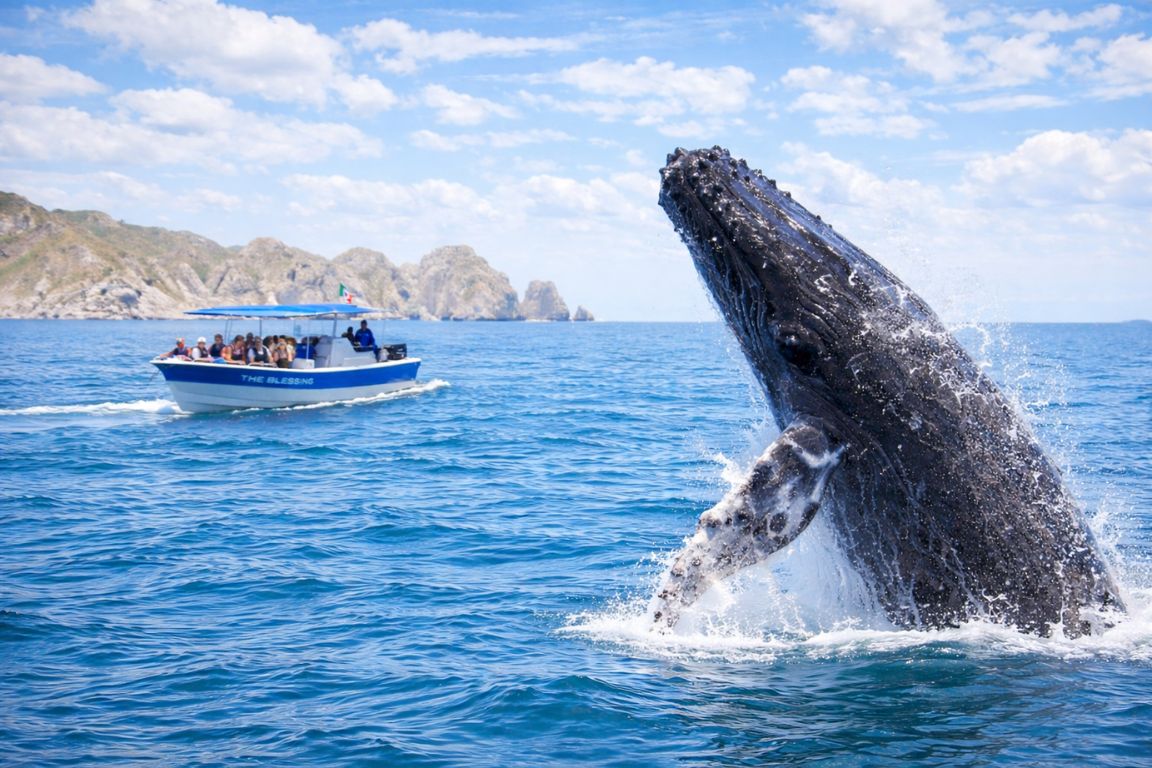
What usually happens is this. A panga sits still with the outboard off. A calf breaks away from its mother, comes over to look, and starts rolling alongside the hull, sometimes lifting its head clear of the water to look straight at the people in the boat. The mother often stays underneath or a few metres off, apparently untroubled, occasionally nudging the calf back toward her when she has had enough. From a low open boat the scale of that is hard to prepare for.
Rules on physical contact vary between lagoons and between permit holders, and the guide on the day will say what is allowed on that boat. One thing does not vary anywhere in Mexico: nobody gets in the water. If you were hoping for that, read the honest answer on swimming with whales in Cabo before you book anything.
It is not a guarantee. Some days whales keep their distance, and no operator controls whether one approaches the boat. Judge the trip by its verified format and current terms rather than an old rating count.
What An Eight-Hour Gray Whale Trip From La Paz Actually Looks Like
The verified Baja Whales product lasts eight hours and starts in La Paz, not Cabo. It includes an air-conditioned vehicle, lunch, water, soda and coffee. La Paz hotel pickup is offered, while Cabo transfer is not included. The listing allows up to 36 participants, so do not describe it as a small-group trip.
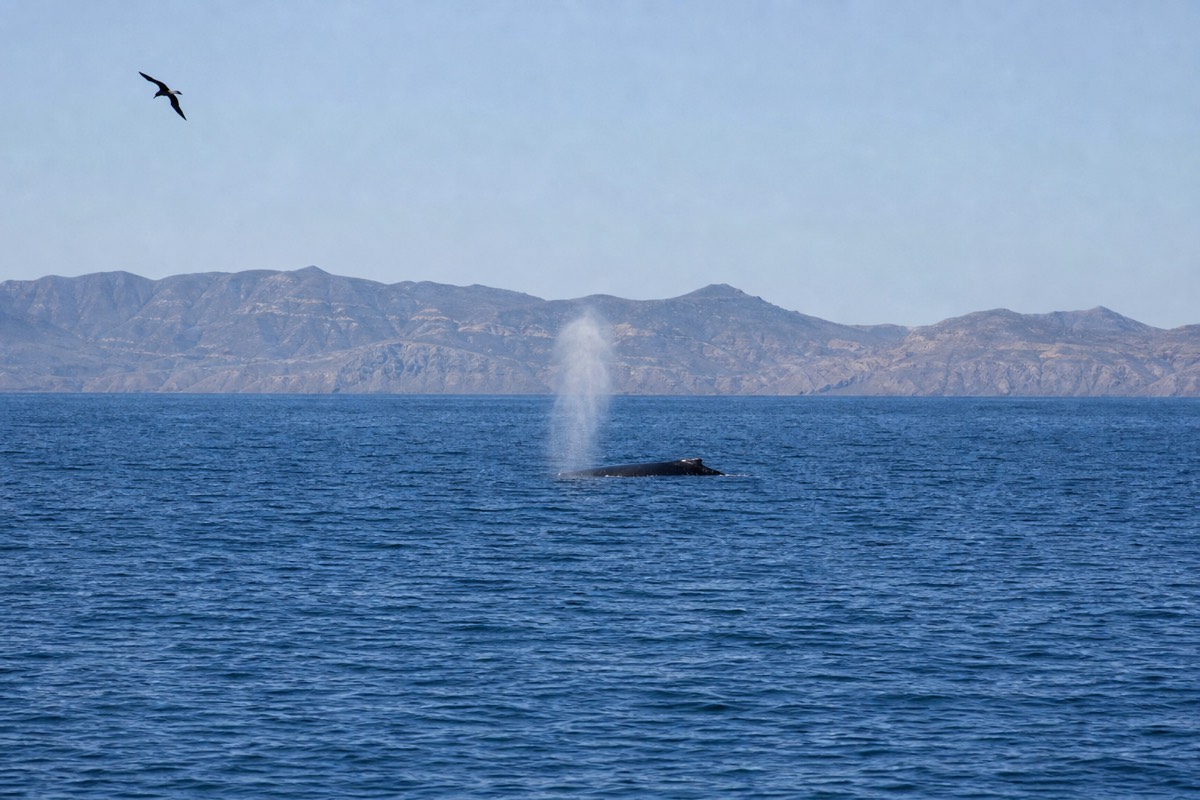
The pickup is early and it is dark. People underestimate this part: you are trading a lie-in and most of a holiday day for one specific animal encounter, and the drive north is long enough that the van becomes part of the experience. The upside is that the driving is done for you on a road that is not fun to navigate yourself, and the guide uses the time to explain what you are about to see.
The panga is the reason the day works. It is an open outboard boat that sits low, with no cabin and no rail to hide behind, which is exactly why an approaching calf feels enormous. It is also why the wind chill on a January morning bites even when Cabo is warm. La Paz is about two hours by road from Cabo and the launch point is further out again, so treat the table below as a planning allowance rather than a timetable.
| Verified stage | What is known |
|---|---|
| Start | La Paz meeting point or offered La Paz hotel pickup |
| Tour duration | 8 hours total |
| Transport | Air-conditioned vehicle included; no Cabo transfer |
| Return | Same La Paz meeting point |
| Before paying | Confirm date, pickup eligibility, route and restrictions |
The exact split shifts with your pickup point, the tide and where the whales are that morning. What does not shift is the shape of the day: a long drive, a concentrated block of water time, food, and a long drive back.
What Does The Day Include, And Is The Price Fair?
The verified eight-hour product includes an air-conditioned vehicle, lunch, water, soda and coffee. It starts at Agustin Arriola 25 and Paseo Alvaro Obregon in La Paz and returns there, with La Paz hotel pickup offered. Check the live listing for price, date and the exact route; do not promise a Cabo transfer, alcohol or gratuities.
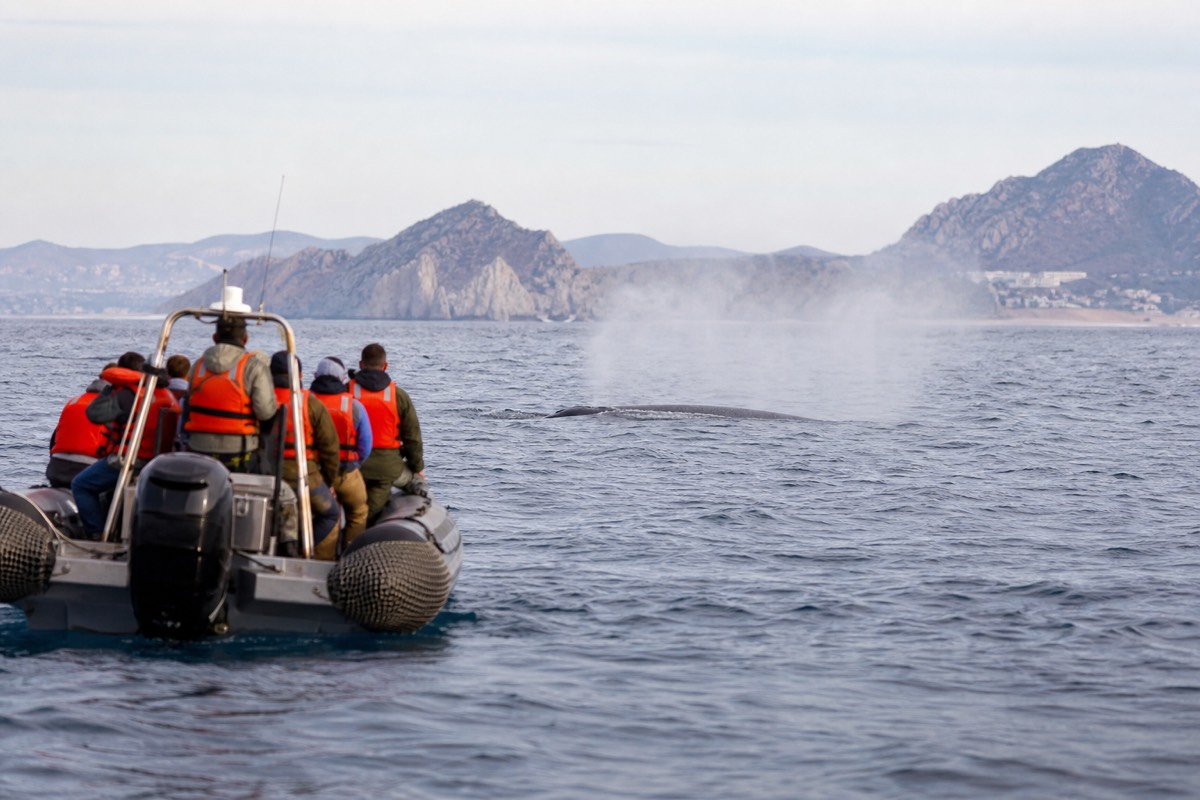
The verified gray-whale product is an eight-hour La Paz departure. Compare it with the 2.5-hour Cabo biologist trip only after deciding whether a lagoon day or a shorter Cabo whale watch matches the actual goal.
If your goal is a shorter Cabo departure, the verified biologist-led trip lasts 2.5 hours and meets at Plaza Bonita. That is a different whale experience from the eight-hour La Paz product; do not treat it as an automatic substitute for a gray-whale lagoon day.
| Item | Verified status |
|---|---|
| Air-conditioned vehicle | Included |
| Lunch | Included |
| Water, soda and coffee | Included |
| La Paz hotel pickup | Offered |
| Cabo transfer | Not included |
| Alcohol and gratuities | Unresolved; do not promise |
Gray Whale Or Humpback: Which One Are You Looking At?
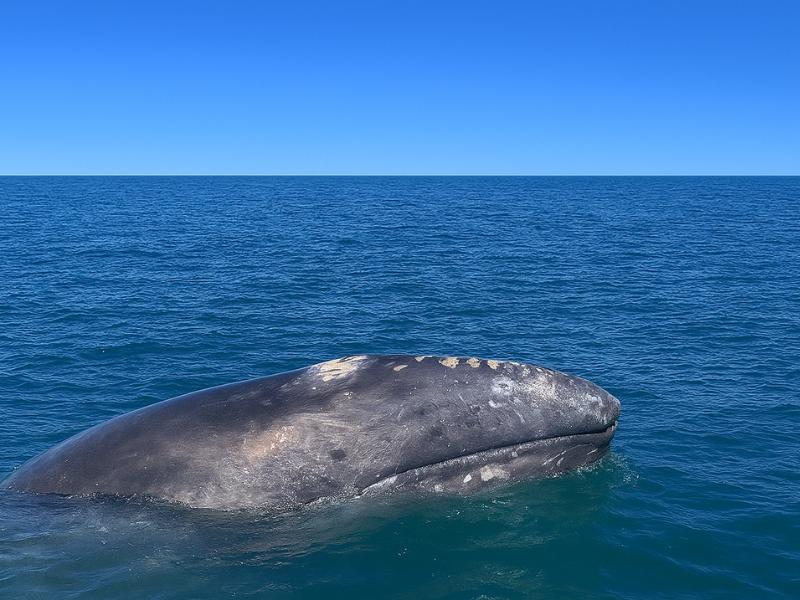
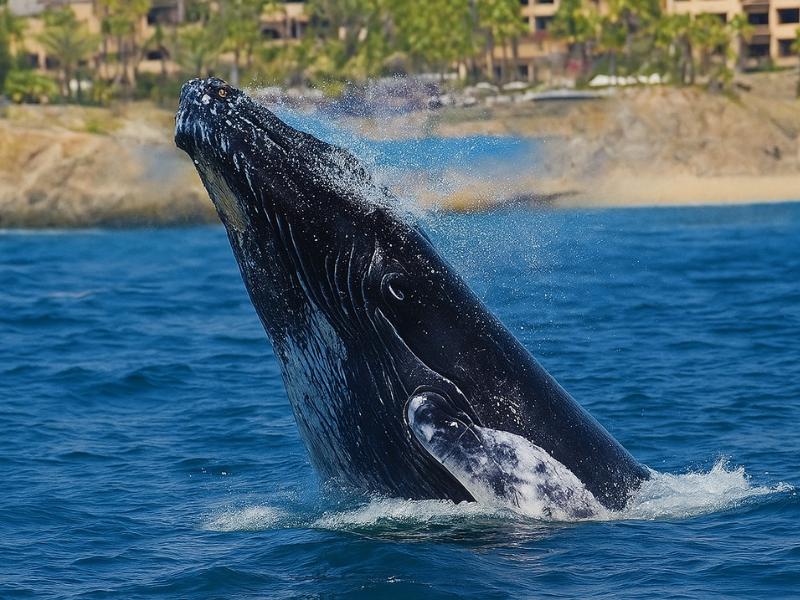
Look at the back. A humpback carries a small dorsal fin set on a raised hump and lifts a broad white-marked fluke before a deep dive. A gray whale has no dorsal fin at all, just a low ridge followed by a row of knuckles down the tail stock, mottled skin crusted with barnacles, and a low bushy blow.
Both species share Baja water through the winter, so the question comes up on almost every boat. The blow gives you the first clue at distance: a gray whale exhale is low, wide and often looks heart-shaped when the animal is coming straight at you, while a humpback throws a taller, straighter column. By the time the back rolls through, the fin question settles it.
Behaviour separates them further. Humpbacks are the acrobats and the singers, and the ones that put on the surface displays people photograph. Grays are travellers, low in the water, undemonstrative at sea and transformed inside the lagoons. If the acrobatics are what you came for, read up on humpback behaviour in Cabo and put your money on a marina boat instead of the road trip.
| Feature | Gray whale | Humpback whale |
|---|---|---|
| Dorsal fin | None; a low hump followed by knuckles | Small fin set on a raised hump |
| Skin | Mottled grey, barnacles and whale lice | Dark back, pale flippers, throat grooves |
| Flippers | Short and paddle-shaped | Very long, up to about a third of the body |
| Blow | Low, bushy, often heart-shaped head-on | Taller, straighter column |
| Fluke on a dive | Lifted, plain grey, notched centre | Lifted, white underside patterns unique to each animal |
| Signature behaviour | Spyhopping, close panga approaches in the lagoons | Breaching, tail slapping, singing males |
| Adult length (NOAA Fisheries) | Up to about 49 feet | Up to about 60 feet |
| Why it is in Baja | Calving and nursing in the Pacific lagoons | Breeding and calving in warm water |
| Where to meet it properly | Magdalena Bay system, full-day trip | Two-hour boat straight out of the Cabo marina |
What Do The Surface Behaviors Mean?
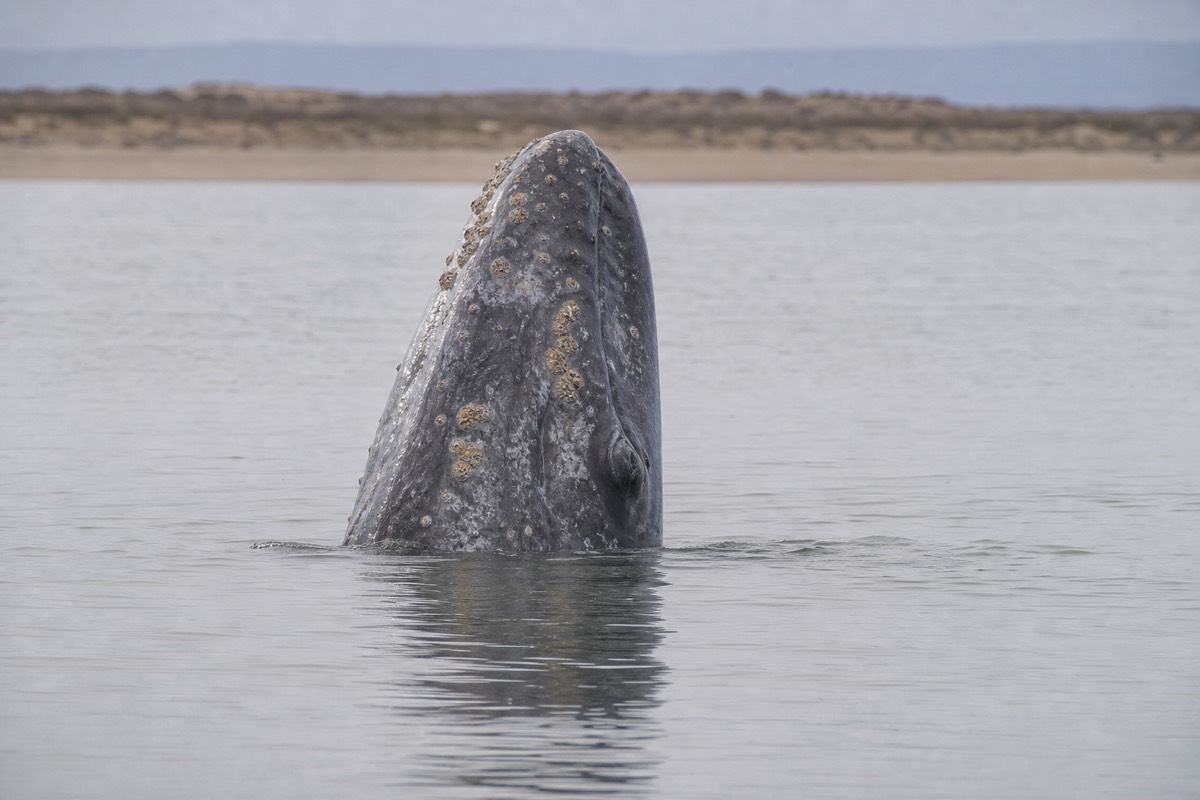
Most of what you watch is a whale doing something practical: breathing, looking, moving or communicating. A blow is an exhale. A spyhop is a look around above the waterline. A fluke-up dive means the animal is going deep and staying down. A breach is the loud one, and its purpose is still argued over.
Knowing the vocabulary changes the trip, because it turns a grey shape into an animal with intentions. It also helps you predict. A whale that blows three times in quick succession and then arches its back high is about to fluke and disappear for several minutes, which is your cue to stop shooting and rest your arms rather than stare at flat water.
Inside the lagoon the mix skews differently from open water. Calves spyhop constantly because they are new and everything is interesting. Mothers log at the surface between dives, conserving energy they cannot replace until Alaska. Breaching happens, but it is not the main event down there, and anyone who books the day expecting an aerial show has misread the animal.
| Term | What it looks like | What it usually means | How likely on a lagoon day |
|---|---|---|---|
| Blow | A column of vapour, usually what you spot first | The whale is exhaling at the surface | Near certain |
| Spyhop | Head rises vertically, eye clear of the water | The whale is looking at boats or the shoreline | Common, especially from calves |
| Fluke-up dive | The tail lifts clear before the animal vanishes | A deeper, longer dive is starting | Common |
| Breach | Most of the body leaves the water | Debated: play, parasite removal, signalling | Occasional |
| Tail slap | The fluke is slammed flat on the surface | Sound that carries; often communication or irritation | Occasional |
| Rolling | The whale turns on its side beside the boat | Relaxed investigation, usually a calf | Lagoon-specific |
| Logging | Floating still at the surface, barely moving | Resting between dives | Common through the middle of the day |
| Mugging | A whale approaches an idling boat and stays | Curiosity, whale-initiated, engine in neutral | The encounter people remember for years |
Which Months Actually Put Calves In The Lagoon?
January through March is the window that matters. Births peak in January, calves are strong and playful by February, and March produces the most confident young whales before the mothers head north. December is early and April is late: whales are present at both ends of the season, but the lagoon is emptier and encounters get less reliable.
The regulated Cabo season runs December 15 to April 15, and the lagoon trips sit inside that same frame. Within it, the curve is steep. A mid-December run can be quiet, with adults arriving and few calves yet born. A late-February run can put half a dozen mother and calf pairs around the panga in a morning. Same price, same drive, different odds.
January through March is the clearest planning window, but only the live listing shows availability. For December or April, confirm the exact operating date before paying.
| Month choice | Booking guidance |
|---|---|
| January through March | Strongest planning window; check live availability |
| December or April | Confirm the exact operating date before paying |
| May through November | Outside this gray-whale product path |
| Any date | No close approach, calf interaction or sighting outcome is guaranteed |
Who Should Skip The Eight-Hour Day?
Skip it if Cabo gives you one free day, if winding road makes you queasy, if you are travelling with a toddler who will not tolerate several hours in a van, or if you fly out that evening. A two-hour boat from the marina delivers whales with none of the road time and a fraction of the commitment.
The trip also suits patient people better than impatient ones. There are stretches where nothing happens: the drive, the wait while the panguero reads the water, the run between channels. Travellers who need constant motion tend to rate the day lower than travellers who came specifically to watch animals. Nothing about the operator changes that. It is a question of temperament.
Motion is the other filter. The road is long and the panga is small and open, so anyone prone to seasickness on small boats should treat medication as part of the packing list rather than an afterthought. Take it before pickup. Taken after the first wave of nausea, it does very little.
What Should You Carry For A Long Day On The Pacific Side?
Dress for a cold open boat and a hot van. Pacific-side mornings run cool and damp even when Cabo is warm, spray reaches every seat in a panga, and there is no shade out there at all. A windproof layer, a hat with a chin cord, reef-safe sunscreen and a dry bag cover most of what the day throws at you.
Layers beat one thick coat, because you will be peeling them off by lunch. Winter water around Baja sits near 21 to 24 degrees Celsius, warm enough that a splash is not miserable, cold enough that wet clothes plus wind is. The list below is a planning allowance, not a shopping order. Adapt it to what you already own and check the site's fuller notes on what to wear and bring.
| Item | Why | Planning allowance |
|---|---|---|
| Windproof outer layer | Open panga, morning wind chill | One per person, packable |
| Warm mid-layer | Lagoon mornings are cooler than Cabo | A fleece or hoodie you can shed |
| Hat with a chin cord | Wind takes hats off pangas | One, plus a spare cap left in the van |
| Reef-safe sunscreen | No shade for around two hours | Apply before boarding, reapply after the panga |
| Polarised sunglasses with a strap | Glare off flat lagoon water | Polarised lenses show you whales below the surface |
| Dry bag or zip bag | Spray reaches every seat | Phone, cash, a copy of your ID |
| Small peso notes | Tips for the panguero and guide | Cash only; no card machine on the dock |
| Motion sickness tablet | Long road plus small boat | Take it before pickup, not after |
| Water and a snack | Long gap between breakfast and a late lunch | One bottle each, refilled in the van |
How Do Mexican Rules Protect Lagoon Whales?
Whale watching in Mexico runs under SEMARNAT permits and the NOM-131 approach standard. Licensed boats display their permit, hold a set minimum distance, cap how many vessels sit with one group of whales, limit how long they stay, and never cut across a whale's path. Swimming with whales is not part of any of it.
NOM-131 sets the working numbers: an approach no closer than about 60 metres, no more than four boats around one group at a time, and observation capped near 30 minutes so the animals get a break. Approaches run parallel and slightly behind, at slow speed, never head-on and never between a mother and her calf. When a whale closes the distance itself, the engine goes to neutral and the boat waits.
That last rule is what makes the friendly-whale encounters legal. The distance limit constrains the boat, not the whale. A calf that chooses to come and sit alongside a stationary panga is behaving normally, and the crew's job at that point is to do nothing interesting. Crews who breach these rules risk their permit, which is a real deterrent in a village where whale season is the year's income.
If you want the international framing rather than the Mexican one, the IWC whale watching handbook is the reference operators and regulators both point at, and it is the clearest short explanation of what responsible whale watching means in practice. Reading five minutes of it before a trip changes how you judge what your own boat does.
Can You See Gray Whales Without Leaving Cabo?
Yes. Grays pass Cabo on the way to and from the lagoons, and the two-hour boats out of the marina report them alongside humpbacks all season. What you get is travelling adults rather than calves at arm's length, plus shore sightings: blows and distant breaches are visible from elevated Pacific-side viewpoints from December into April.
A verified 2.5-hour biologist-led trip leaves from Plaza Bonita in the Cabo San Lucas marina and includes photos and a hydrophone when conditions allow. It can serve readers who explicitly choose a shorter Cabo whale watch, but it is not a substitute for a gray-whale lagoon itinerary and cannot promise both species.
Free viewing works better than people expect. Whales are regularly visible from land through the season, and binoculars turn a distant puff of spray into a recognisable animal. The limitation is behaviour: from shore you get blows and the occasional breach at range, never the detail. If you want to test the water before committing money, start with spotting whales from the shore.
How Should The Gray Whale Day Fit Into A Cabo Week?
Treat it as an entire day gone, and keep it away from arrival and departure days. Book it mid-trip, keep the day before light, and if the La Paz whale shark trip is also on your list, leave at least a day between them. Both are long road days, and back to back they wear people out.
Arrival day is the classic mistake. Flights into Los Cabos land at every hour, transfers take time, and a pickup before dawn the next morning after a late arrival turns the best part of the trip into a blur. Give yourself one ordinary Cabo day first: a marina walk, a two-hour boat, an early night.
A separate whale-shark outing starts from La Paz and follows different season and permit rules. Check its current listing for duration, price, transfer and inclusion details rather than using an old figure here.
Book early for February and March, later for December and April, and prioritise morning departures whatever the month. Calm seas, rested whales and better light all sit in the first half of the day, and those are the boats that fill first.