Swimming With Whale Sharks In La Paz From Cabo (2026)
The whale shark trip from Cabo is a long road day wrapped around a short, tightly controlled swim. Here is the season window, how the in-water rules work, what the ten hour day actually costs, and who should book something else instead.
When the whale sharks are actually in the bay
October through April is a planning window, not a guarantee that the activity will operate on a particular date. Confirm the live departure, current permit status, and conditions with the operator; sightings are not guaranteed.
This is a long Cabo-to-La Paz day built around a tightly controlled wildlife opportunity, so the product choice must work before any cost or packing decision does. The prompts below keep the verified 10-hour trip central and offer a boat-based whale day only where the article compares experiences. Compare The Cabo Tour Options Below →
The verified whale shark trip includes round-trip Cabo transport, gear, wetsuit, life jacket, towels, breakfast and taco lunch for a maximum of 10 guests age eight or older. Exact operation and wildlife access depend on the date and conditions, and sightings are not guaranteed.
What Is The Whale Shark Day Trip From Cabo Actually Like?
The verified product is a ten-hour day with round-trip Cabo transport and a small-group boat segment in La Paz. Use the confirmation for the exact pickup, route, and schedule.
The verified Cabo Adventures trip is a ten-hour day with round-trip Cabo transport, English- and Spanish-language guidance, a maximum group size of ten, gear, towels, breakfast, and a taco lunch. A photographer is present, but the photo product costs extra. Confirm the live date and permit status before booking.
Expect the in-water portion to be one part of a ten-hour day. Search time, swimmer rotations, and visibility vary with conditions and the current protected-area rules.
What you get in exchange is an encounter that no Cabo whale boat can offer. Whale watching happens at a legally mandated distance, from a deck, looking down. This one happens at eye level, with a fish the size of a minibus moving past your mask on its own terms. If you want the difference spelled out before you spend the money, the comparison table further down this page sets the two experiences side by side.
When Can You Swim With Whale Sharks In La Paz?
Use October through April to plan, then confirm that the selected date is operating under the current permit and conditions.
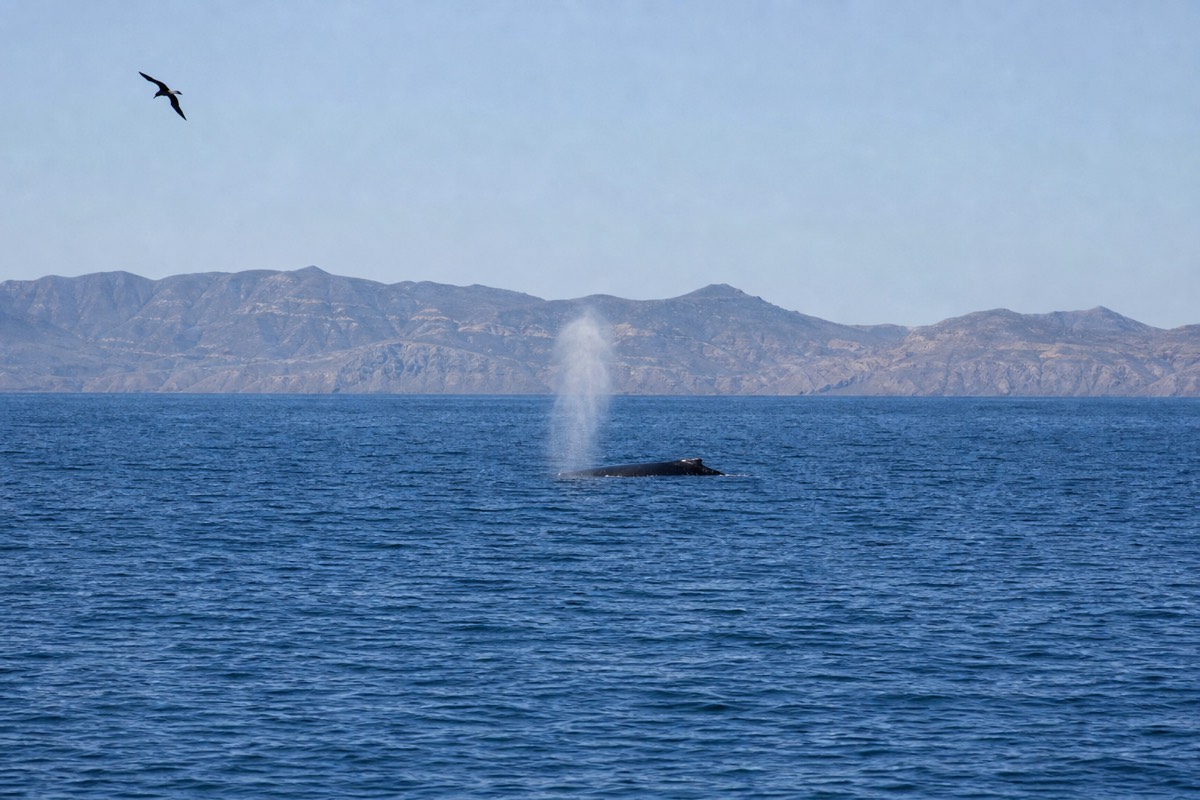
That overlap is the single most useful planning fact on this page. Whale season in Cabo is regulated to December 15 through April 15, with the peak in January and February, so anyone visiting in the back half of winter can do both animals on separate days without changing hotels. Visitors arriving in October or early November get whale sharks at their best and no whales at all, which is why November trips built around whales face 80 to 90 percent disappointment.
Weather, not the calendar, decides individual days. Winter north winds chop the bay and push visibility down, and operators would rather move you to another date than run a bad one. Build a spare day into any trip where the whale shark swim is the reason you flew.
| Month | Planning use | Required confirmation |
|---|---|---|
| October-November | Within the article’s planning window. | Exact operating date, current permit and conditions |
| December-April | Within the planning window; can overlap whale-trip planning. | Whale-shark date and permit; Dec/Apr whale dates need separate confirmation |
| May-September | Do not assume the featured trip operates. | Ask the operator before planning travel |
Treat that table as a planning allowance rather than a timetable. It reflects the season window operators work to and the whale calendar the site tracks, but the departure dates that are genuinely open in any given week live on the live listing.
What Does The Day Look Like Hour By Hour?
Pickup lands somewhere between six and seven in the morning, the drive north takes about two hours, and the boat is usually in the bay by mid-morning. Search and swim rotations fill roughly two hours on the water. Lunch and a walk along the La Paz boardwalk follow, then the drive south. Most people are back in Los Cabos late afternoon.
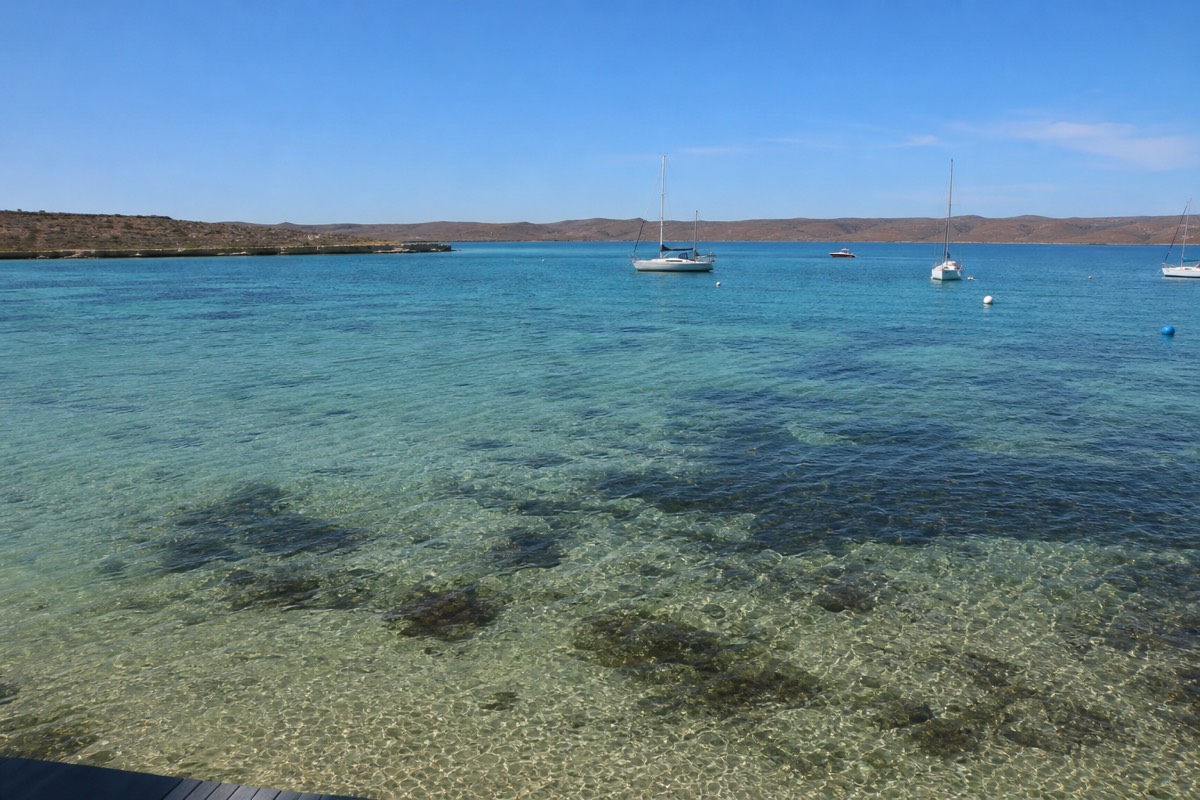
Treat the schedule below as a planning outline. Pickup time and the order or duration of stops can change; use the live confirmation for your exact pickup window and day plan.
| Stage | Plan for | Confirm |
|---|---|---|
| Pickup and road transfer | Part of the ten-hour day; round-trip Cabo transport is included. | Exact pickup point and time |
| Boat and snorkeling | Search and in-water time vary with wildlife and conditions. | Current permit, briefing and equipment process |
| Meals and return | Breakfast and taco lunch are included. | Dietary needs and return estimate |
Ten hours sounds punishing on paper. In practice the driving is comfortable, the boat time is short, and the flat spot is the mid-afternoon return leg, when everyone sleeps. Families with young children usually find the road legs harder than the swim, which is one reason a two hour whale watching boat from the marina suits small kids far better.
The part of the schedule most likely to move is the search window. If the sharks are close to the marina the boat is on animals within twenty minutes and everyone gets several rotations. If the bay is windy or the plankton has shifted, the same two hours become mostly searching with one or two short entries at the end. That variance is the honest reason nobody sells this day with a promise attached, and the reason the boat time is padded rather than tight.
Plan the rest of your day around a late finish rather than the stated one. Traffic on the road south, a longer search, or a group that needs extra time in the water all push the return, and the difference between arriving back at five and arriving back at six matters if you have a dinner reservation. Treat the whale shark day as the only fixed item on that date.
How Is The In-Water Encounter Regulated?
The operator and guide should explain the current protected-area and in-water rules before entry. Follow that briefing and confirm the departure’s permit status; fixed swimmer counts or procedures in an older article may change.
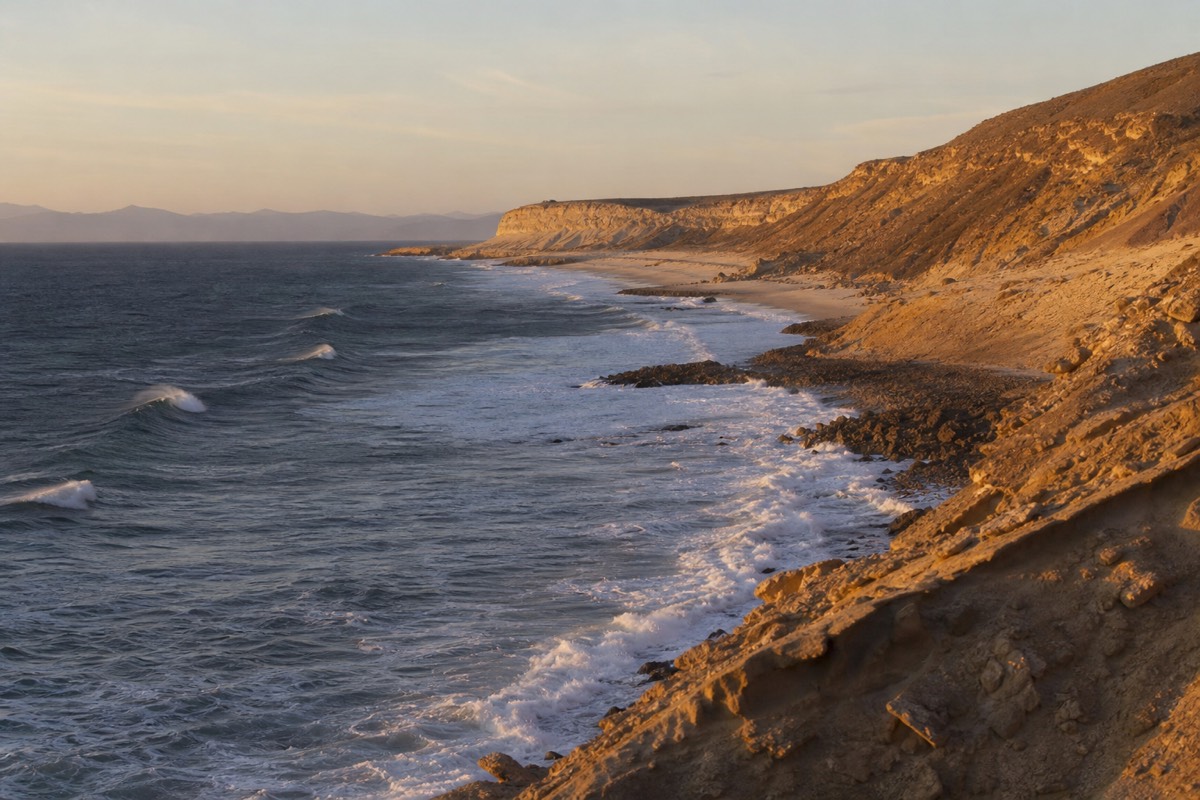
This matters more than it sounds. Whale sharks are the largest fish in the sea, they are filter feeders with no interest in you whatsoever, and the entire risk sits on the human side of the equation. Crowd an animal and it sounds, meaning it drops out of reach, and the encounter is over for everybody on the boat. The rules exist to keep the sharks surfacing rather than avoiding the bay altogether.
Mexican whale and shark tourism sits under SEMARNAT permits and protected-area management, the same framework that governs whale watching off Cabo. Operators who work the bay carry the paperwork visibly and brief it before you get wet. The international reference point for the underlying approach principles is the IWC whale watching handbook, and NOAA Fisheries maintains the plain-language species pages worth reading before you go.
| Topic | Traveler action |
|---|---|
| Permit | Confirm that the selected date is operating under the current permit. |
| Water entry | Follow the guide’s briefing on entries, distance and swimmer rotations. |
| Contact and photography | Follow the current instructions given before entry. |
| Wildlife | Expect no sighting guarantee. |
One rule people ask about constantly is whether the same thing is possible with humpbacks. It is not. Swimming with whales is prohibited across Mexico, which is covered in more detail in the explainer on why you cannot swim with whales in Cabo. Whale sharks are fish, they fall under a different regime, and La Paz is the only realistic place in this corner of Baja to get in with one legally.
What Does It Cost, And Is Booking The Pieces Separately Cheaper?
Compare the live total with a self-arranged day only after checking transport, permitted-boat access, gear, meals, and cancellation terms. The verified trip includes round-trip Cabo transport, gear, towels, breakfast, and a taco lunch; photos, tips, and optional purchases cost extra.
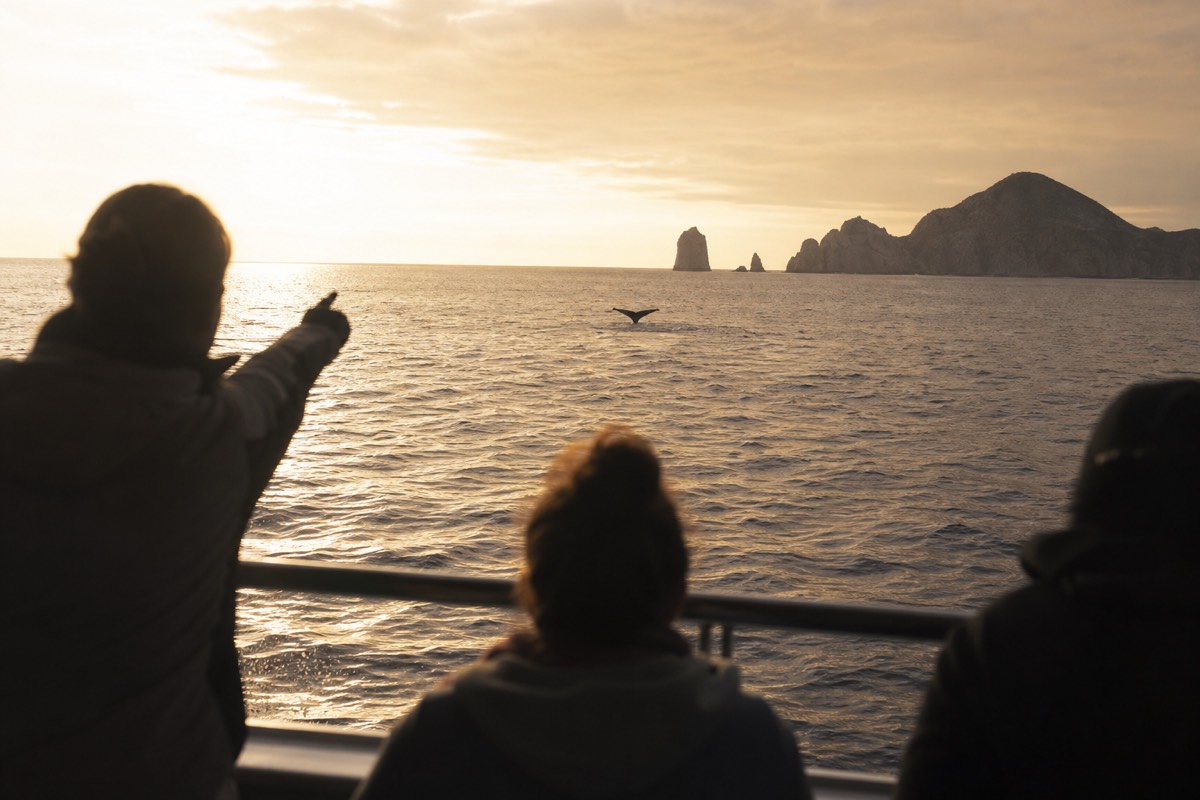
A self-arranged day requires separate transport and a currently authorized boat. Compare live totals and verify the operator’s permit rather than assuming a particular marina seller is authorized or unauthorized.
| Trip piece | Verified packaged trip | If arranging separately |
|---|---|---|
| Cabo transport | Round trip included | Confirm the complete road plan |
| Boat and guide | Included; group capped at 10 | Verify current permit and operator |
| Gear and towels | Snorkel gear, wetsuit, life jacket and towels included | Confirm each rental or item |
| Food | Breakfast and taco lunch included | Plan and price food separately |
| Photos | Photographer present; photo product costs extra | Plan your own camera within current rules |
Choose this full day when the in-water whale-shark experience is the priority. Compare the live total and schedule with separate Cabo boat trips rather than relying on old price examples.
What Is Included, And What Do You Bring Yourself?
The verified trip provides snorkel gear, wetsuit, life jacket, towels, transport, breakfast, taco lunch, and a guide. A photographer is present, but the photo CD costs extra. Confirm dietary needs and sunscreen rules with the operator; ask a pharmacist or clinician about motion-sickness medicine.
| Item | Verified status | Traveler check |
|---|---|---|
| Snorkel gear, wetsuit, life jacket | Included | Confirm sizing |
| Towels | Included | Bring dry clothes if wanted |
| Breakfast and taco lunch | Included | Confirm dietary needs |
| Photos | Photo product costs extra | Confirm current price if interested |
| Tips and optional purchases | Extra | Bring only if desired |
The broader kit thinking for boat days in Baja, including which sunscreen formulations operators actually accept, is covered in the guide on what to wear and bring on a boat day. Most of it transfers directly to this trip, with one change: you will be wet, so the layers matter on the drive home rather than on the water.
What Actually Happens When You Get In The Water?
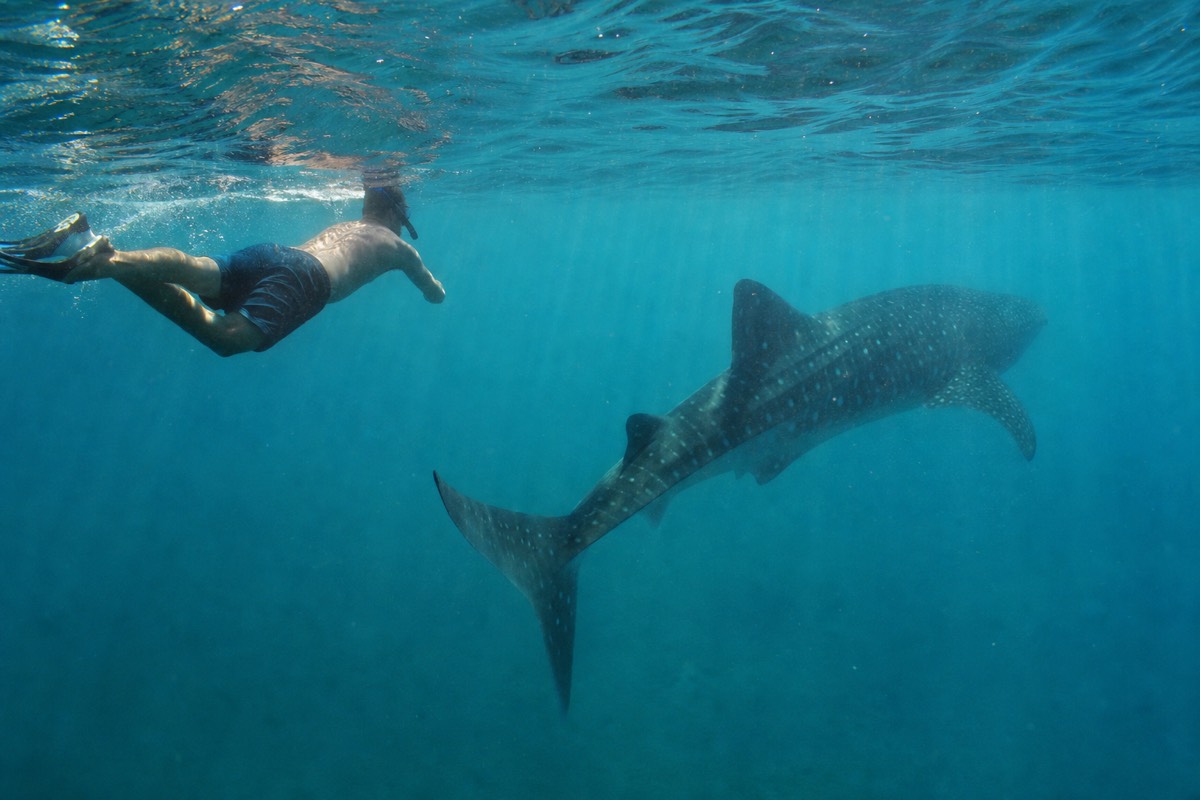
The boat finds a feeding shark, positions ahead of its line, and the guide calls a small group to the rail. You slide in quietly, fin to the side of the animal, and swim alongside for as long as it tolerates you. Then it turns or drops, the guide calls you back, and the boat repositions for the next pass.
The pace surprises people. A whale shark cruising and feeding looks unhurried, and it is not. Its tail beat covers ground far faster than a person in a wetsuit can fin, so a pass ends when the animal decides it ends. Some passes give you thirty seconds of company. Some give you two or three minutes if the shark is feeding in circles and barely moving.
Technique makes a real difference to how much you see. Get your mask on and clear before you go in, because sorting it out at the surface wastes the whole pass. Fin steadily rather than sprinting, since thrashing burns air and pushes water at the animal. Stay level with the body rather than swimming for the head, both because the rules require it and because the head-on view is the one that ends encounters. Keep your camera hand still and let the shark move through the frame.
Cold is the other variable nobody plans for. Winter water in this part of Baja sits around 21 to 24 degrees Celsius, which is pleasant for a few minutes and steadily less pleasant across an hour of repeated entries in a wet suit sitting in the wind between rotations. The wetsuit handles it. A rash guard underneath handles it better.
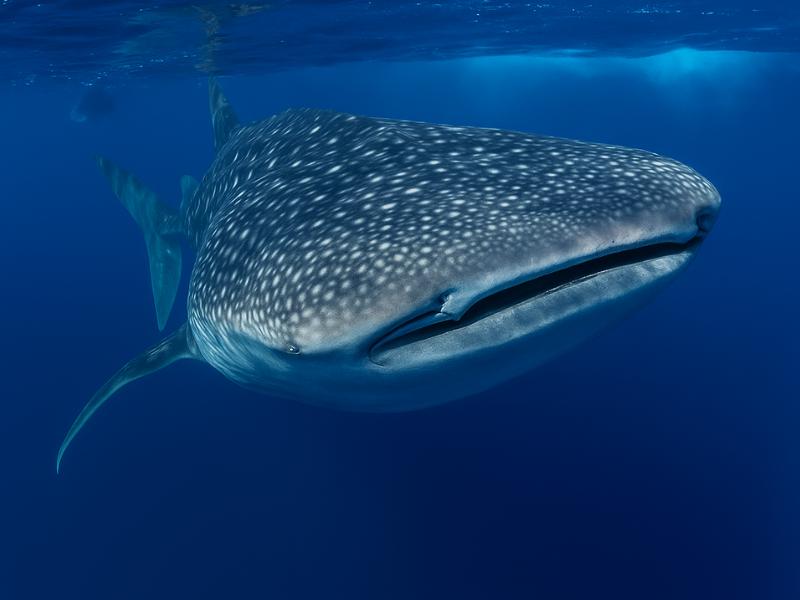
What you actually see up close is stranger than the photographs suggest. The mouth is enormous and blunt, held slightly open, straining water rather than hunting anything. Behind it the gill slits pulse in a rhythm you can hear through the water if the boat engines are off. The skin carries a pattern of pale spots and lines over dark grey, and that pattern is individual to each animal, which is how researchers track returning sharks between seasons from nothing but photographs.
Small fish travel with them, and there are usually remoras clamped along the flanks. None of it is threatening. The most disorienting thing about the encounter is the scale mismatch: something that large moving that calmly a metre from your shoulder reads as slow right up until you try to keep pace with it.
The guides are worth listening to closely rather than politely. They read the animal's behaviour to decide where to drop you, and a bad entry, splashing, or a swimmer cutting across the head will end a pass that could have run for minutes. Groups that follow instructions tightly generally get more water time, because the shark stays at the surface instead of dropping away from the boat.
Whale Shark Or Whale? The Comparison That Decides Your Booking
They are different experiences. The verified whale-shark product is a 10-hour in-water day with a minimum age of eight and specific health and access restrictions. Whale-watching products are boat-based and have their own passenger restrictions; neither experience suits everyone.
| Decision | Whale-shark day | Cabo whale watch |
|---|---|---|
| Experience | In-water snorkeling with whale sharks | Whale viewing from a boat |
| Time | 10-hour Cabo round trip | 2 to 3 hours for featured options, plus transfers |
| Dates | Confirm selected date and current permit | Jan-Mar match; confirm December or April |
| Eligibility | Minimum age 8 and listed medical/access exclusions | Product-specific limits apply |
| Wildlife | Sightings not guaranteed | Sightings not guaranteed |
People who have time for exactly one water day in winter usually get more out of a whale boat, because the animals are closer to town, the odds are higher, and two hours leaves the rest of the day intact. People who have a week and a taste for the water tend to do both, then argue about which was better for the rest of the trip.
Why Do Whale Sharks Gather In Bahia De La Paz?
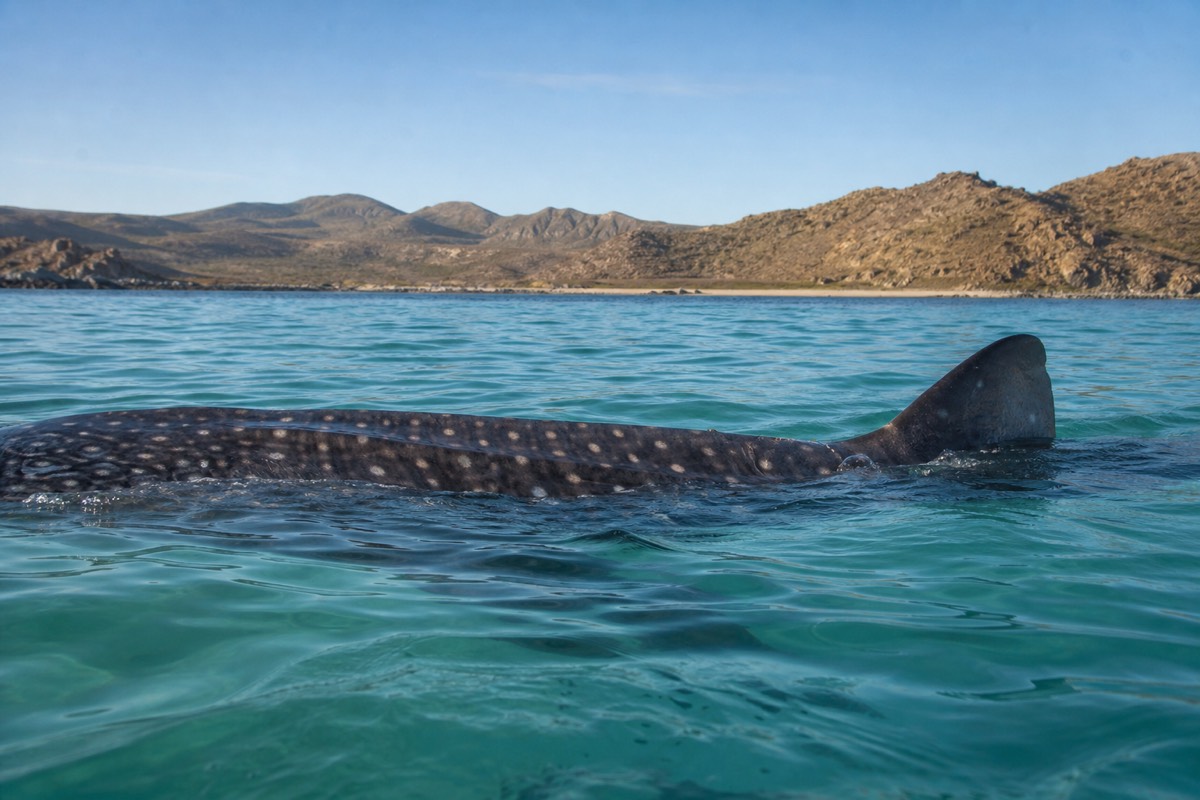
Food and shelter. The bay is shallow, warm and largely enclosed by the long sandspit of El Mogote, which lets plankton concentrate instead of dispersing into open water. Juvenile whale sharks use it as a feeding ground through the cooler months, cruising the surface with their mouths open where boats and snorkelers can reach them.
The juvenile part explains a lot about the experience. Adults roam open ocean and are rarely part of this encounter. The animals working the bay are younger fish, which is why they are surface-feeding in water shallow enough for a snorkeler to be useful company rather than a distant speck. It is also why the protections are strict: this is a nursery-scale aggregation in a small piece of water, and it does not take many careless boats to move it somewhere else.
The geography also explains the schedule. The Sea of Cortez cools through autumn, plankton blooms, the sharks arrive. As spring warms the water the food thins and the animals leave. Nothing about that calendar is negotiable, which is why the season is worth planning around rather than hoping for.
It helps to picture the wider system. The Sea of Cortez is a long, narrow, deep sea that funnels nutrient-rich water up from the depths, and the whole peninsula's wildlife calendar hangs off that productivity. The same seasonal engine that fills La Paz with feeding whale sharks is what brings humpbacks down the outer coast to breed and pulls gray whales into the Pacific lagoons. Cabo San Lucas sits at the hinge between the two systems, which is why one small town can offer such different animal encounters within a couple of hours of each other.
Sightings are not guaranteed. Confirm the current date, permit status, wildlife policy, and cancellation or rescheduling terms before paying.
Who Should Skip This Trip?
The verified trip has a minimum age of eight and is not suitable for pregnancy, back or neck problems, mobility impairment, or wheelchair use. Anyone with an access or medical concern should ask the operator to confirm suitability before paying; sightings and operation are not guaranteed.
Swimming ability is the honest filter. You are entering deep, open water from a moving boat, in a wetsuit that changes how you float, with a large animal nearby and a guide managing several people at once. Nobody expects competitive form, but you should be comfortable putting your face in the water, breathing through a snorkel without panic, and finning steadily for a couple of minutes at a time.
The long road transfer and small-boat segment can affect comfort. If motion sickness is a concern, ask a pharmacist or clinician for individual advice before travel and follow the operator’s current preparation instructions.
Anyone whose priority is whale behaviour rather than in-water contact should put the money into a Cabo boat instead. The month-by-month reasoning for that decision sits in the guide on the best months to see whales in Cabo.
What Should You Pack For The Day?
Wear your swimsuit under your clothes so you never queue for a changing room, then pack for two environments: a boat in the wind and a van with air conditioning. A towel, dry clothes, mineral sunscreen, motion sickness tablets and pesos cover almost everything that goes wrong on this trip.
| Bring | Why |
|---|---|
| Swimsuit and dry clothes | For the in-water portion and return trip comfort |
| Sun and weather protection | Conditions vary during a long day |
| Personal medicines as directed | Keep them protected and accessible |
| Booking confirmation | Contains the current pickup and operator instructions |
| Motion-sickness plan if needed | Get individual advice from a pharmacist or clinician |
Can You Do Whale Sharks And Whales On The Same Holiday?
Yes, from mid-December to mid-April, and it works best as two separate days. Give the whale shark trip a full day of its own, then take a short morning whale boat from the Cabo marina on a different date. February and March are the strongest overlap, with both activities running and settled weather on both sides of the peninsula.
The verified whale trips use product-specific arrangements: Plaza Bonita, IGY Dock C, or an arranged catamaran transfer. Keep the ten-hour whale-shark day separate and use each booking confirmation for logistics.
There is a third animal day worth knowing about if you have the time. The Gray Whale Watching full-day tour runs from La Paz out to Puerto Chale on the Pacific side, listed around $188 for a nine hour day with a two hour panga session, a mangrove cruise and lunch. Gray whale mothers and calves in those lagoons behave nothing like the humpbacks off Cabo, and the difference is the subject of the dedicated guide on gray whale watching in Baja.
Three long days in a week is too many. Pick one long day and one short one, and keep the rest of the holiday for the beach.
How Far Ahead Should You Book?
The verified trip caps the group at ten. Check live availability when your dates are firm, and confirm the operating date and permit status rather than relying on a fixed booking lead time.
The pressure points are the US holiday weeks. Presidents Day and Spring Break compress demand into narrow windows, and the small-boat departures are the first to disappear because they physically cannot add seats. If your dates fall in those weeks, book the whale shark day before you book anything else, then arrange the rest of the week around it.
Weather cancellations are the other reason to book early rather than late. If a wind day moves you, an operator with an open calendar can put you on another departure. An operator working the last week of spring break cannot. Keeping a flexible day in reserve is the cheapest insurance available, and it is the same advice that runs through the month-by-month season calendar for whale trips.
Sightings are not guaranteed. Ask about the reschedule and cancellation policy before paying, confirm current permitted operation for the selected date, and review every participant restriction. If this product does not fit, choose another activity rather than treating a whale-watching boat as the same experience.